
Selection Basis for Wear-Resistant Coating Materials of Tungsten Carbide Die
With the rapid development of modern industry, dies play a crucial role in various mechanical processing, stamping, forming, and other processes. Tungsten carbide die, known for its high hardness, high […]
With the rapid development of modern industry, dies play a crucial role in various mechanical processing, stamping, forming, and other processes. Tungsten carbide die, known for its high hardness, high strength, excellent wear resistance, and corrosion resistance, holds a pivotal position in the die industry. However, dies often face problems such as wear and corrosion during use, which directly affect their service life and processing quality. To enhance the wear resistance of tungsten carbide die and extend its service life, selecting appropriate wear-resistant coating materials is of paramount importance.
I. Basic Characteristics and Applications of Tungsten Carbide Die
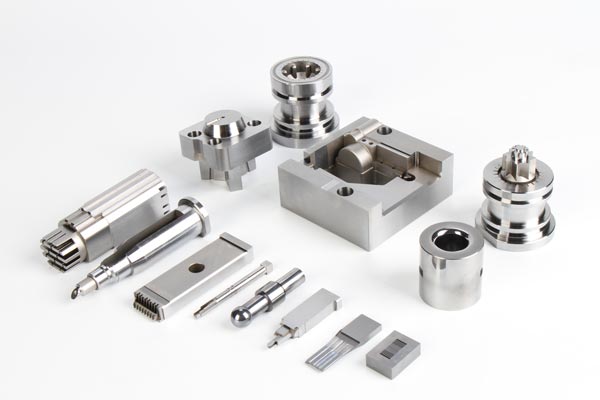
Tungsten carbide die is usually made of tungsten-cobalt alloy and features high hardness, high strength, corrosion resistance, and high-temperature resistance. With a small expansion coefficient, it can maintain stable dimensions and shapes under high-temperature and heavy-load conditions. Therefore, it is widely applied in various high-precision and high-efficiency mechanical processing processes. Nevertheless, even tungsten carbide die with such excellent performance is prone to wear and corrosion after long-term use, thereby affecting processing accuracy and die life. Consequently, surface treatment of tungsten carbide die, especially the application of wear-resistant coatings, has become a key means to improve its performance.
Our factory business: carbide parts, mold parts, medical injection molds, precision injection molds, teflon PFA injection molding, PFA tube fittings. email: [email protected],whatsapp:+8613302615729.
II. Selection Principles for Wear-Resistant Coating Materials
When selecting wear-resistant coating materials, multiple factors need to be considered comprehensively, including the hardness, wear resistance, corrosion resistance, bonding strength of the coating, and its compatibility with the substrate. The following are some key selection principles:
Hardness and Wear Resistance: A Solid Defense Against Wear
The hardness and wear resistance of the coating are the primary considerations. A high-hardness coating can effectively resist the indentation and scratching by external substances, reducing wear on the die during use. For example, hard alloy coatings such as tungsten carbide have a much higher hardness than steel materials, significantly improving the wear resistance of the die.
Corrosion Resistance: An Essential Quality for Adapting to Complex Environments
In certain specific working environments, dies may come into contact with corrosive media. Therefore, the corrosion resistance of the coating is also an important consideration. Nitride and oxide coatings generally have good corrosion resistance, providing reliable protection for the die against chemical corrosion.
Bonding Strength: The Key to Ensuring the Long-Term Durability of the Coating
The bonding strength between the coating and the substrate directly affects the service life of the coating. The coating should form a good metallurgical bond with the substrate to prevent detachment or cracking during long-term use, ensuring the stable performance of the die.
Compatibility with the Substrate: An Invisible Guarantee to Avoid Stress Problems
The coating material should have good compatibility with the tungsten carbide substrate to prevent stress concentration and cracking caused by mismatched thermal expansion coefficients, ensuring the safety and stability of the die during use.
III. Common Wear-Resistant Coating Materials and Their Characteristics
Hard Alloy Coatings: The Paragon of High Hardness and Wear Resistance
Hard alloy coatings, such as tungsten carbide coatings, are renowned for their extremely high hardness and wear resistance. They are usually prepared using advanced technologies such as physical vapor deposition (PVD) or chemical vapor deposition (CVD), forming a dense hard alloy film on the surface of the die and providing excellent wear protection.
Nitride Coatings: Representatives with Comprehensive Excellent Performance
Nitride coatings, such as titanium nitride and chromium nitride, improve hardness and wear resistance by forming a nitride film on the surface of the die. At the same time, these coatings also have good corrosion resistance and can adapt to a variety of complex working environments, demonstrating strong comprehensive performance.
Carbide Coatings: Diverse Choices with High Hardness
In addition to tungsten carbide, carbide coatings such as titanium carbide and chromium carbide also have high hardness and excellent wear resistance. They can effectively protect the surface of the die from damage caused by friction and collision, providing strong support for the stable operation of the die.
Oxide Coatings: A Dual Guarantee of Wear and Corrosion Resistance
Oxide coatings, such as aluminum oxide and chromium oxide, have both good wear resistance and corrosion resistance. They are generally prepared using methods such as thermal spraying or electrochemical deposition and are suitable for dies of different shapes and sizes, providing comprehensive protection for the die.
IV. Application Effects of Wear-Resistant Coatings: Cases Witnessing Performance Improvement
In actual production, numerous application cases fully demonstrate the significant improvement in the performance of tungsten carbide die brought about by wear-resistant coatings. For example, after applying a tungsten carbide coating to a high-precision stamping die, its service life increased by several times, and the processing accuracy and stability also improved significantly. In another case, a titanium nitride coating was applied to a cold stamping forming die, effectively reducing friction and minimizing scratches and wear during processing. This not only extended the service life of the die but also reduced production costs, bringing considerable economic benefits to enterprises.
V. Conclusion and Prospects: Innovation Drives the Future of the Die Industry
In conclusion, wear-resistant coatings are one of the key technologies for improving the performance of tungsten carbide die. By scientifically and reasonably selecting coating materials and continuously optimizing the preparation process, the wear resistance, corrosion resistance, and service life of the die can be significantly enhanced. With the continuous progress of science and technology, new coating materials and advanced coating preparation technologies will emerge continuously, opening up more possibilities for improving the performance of tungsten carbide die. Looking ahead, we are full of expectations and believe that more innovative coating solutions will be widely applied in the die industry, driving the entire industry towards continuous progress and development.
Related Posts
- How to Enhance the Performance of Tungsten Carbide Die through Heat Treatment
- Enhancing the Performance of Tungsten Carbide Die through Advanced Manufacturing Technologies
- The Impact of the Precision of Tungsten Carbide Die on Machining Quality
- Polishing Techniques for Tungsten Carbide Dies: A Comprehensive Guide and Practical Manual


 English
  Deutsch
  Français
  日本語
日本語  한국어
한국어  Español
  Português
  Italiano
  Nederlands
  Русский
  Bahasa Indonesia
  العربية