

How to Accurately Inspect the Precision of Tungsten Carbide Dies
Introduction Tungsten carbide dies play an indispensable role in the manufacturing industry due to their exceptional hardness, outstanding wear resistance, and excellent thermal stability. The precision of a die directly […]
Introduction
Tungsten carbide dies play an indispensable role in the manufacturing industry due to their exceptional hardness, outstanding wear resistance, and excellent thermal stability. The precision of a die directly determines the quality of the final product and overall production efficiency. Therefore, accurate precision inspection of tungsten carbide dies is of paramount importance. This article provides a comprehensive overview of the key steps, methods, and precautions involved in tungsten carbide die precision inspection, ensuring the accuracy and reliability of die quality verification.
1. Key Steps in Tungsten Carbide Die Precision Inspection
Define Inspection Objectives and Requirements
Our factory business: carbide parts, mold parts, medical injection molds, precision injection molds, teflon PFA injection molding, PFA tube fittings. email: [email protected],whatsapp:+8613302615729.
Before commencing the precision inspection of tungsten carbide dies, it is essential to clearly define the inspection objectives and requirements. This includes identifying the dimensions, geometric shapes, positional tolerances, and other parameters to be measured, as well as the required precision levels and applicable inspection methods. Only with clearly defined objectives can the appropriate inspection methods and equipment be selected with precision.
Prepare Inspection Equipment and Tools
Based on the defined objectives, the corresponding inspection equipment and tools must be prepared. Commonly used precision inspection equipment for tungsten carbide dies includes coordinate measuring machines (CMM), optical projectors, microscopes, and hardness testers. In addition, specialized fixtures and measuring tools must be prepared to ensure the accuracy and reliability of the inspection process.
Clean and Prepare the Die Surface
Prior to precision inspection, the surface of the tungsten carbide die must be thoroughly cleaned and prepared. This involves removing oil stains, dust, and other contaminants from the die surface, as well as inspecting for scratches, pits, or other surface defects. Only when the die surface is clean and level can accurate inspection results be obtained.
Conduct Precision Inspection
Based on the established objectives, select the appropriate inspection method and perform precision measurement on the tungsten carbide die. Common inspection methods include dimensional measurement, shape inspection, and positional inspection. During the inspection process, strict adherence to standard operating procedures is required to ensure accuracy and reliability.
Data Processing and Analysis
The data collected during inspection must be processed and analyzed to evaluate whether the tungsten carbide die meets the required precision standards. Data processing methods include comparative analysis and statistical evaluation. Through systematic data analysis, potential issues with the die can be identified in a timely manner, providing a solid basis for subsequent die improvement and maintenance.
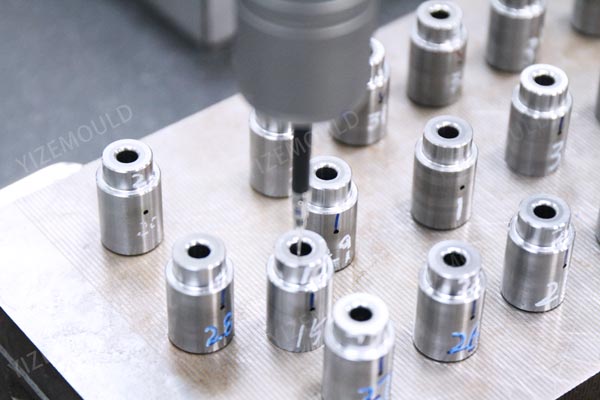
2. Core Inspection Methods for Tungsten Carbide Die Precision
Coordinate Measuring Machine (CMM) Inspection
The coordinate measuring machine is a high-precision instrument capable of performing three-dimensional dimensional measurement and shape inspection on tungsten carbide dies. It can accurately measure all dimensional parameters of the die, including length, width, height, and diameter, as well as conduct high-precision shape verification. The CMM offers high measurement accuracy, fast speed, and a high degree of automation, making it one of the most important devices for tungsten carbide die precision inspection.
Optical Projector Inspection
The optical projector is a widely used optical measurement device suitable for two-dimensional dimensional measurement and shape inspection of tungsten carbide dies. By projecting the die contour onto a screen, measurements can be taken using scales and verniers. The projector offers high precision and ease of operation, making it ideal for rapid inspection of die contours and critical dimensions.
Microscope Inspection
The microscope is an optical instrument designed for observing micro-scale features. It enables detailed inspection of the surface quality and microstructure of tungsten carbide dies. Through the microscope, operators can observe surface micro-topography, texture, defects, as well as measure surface roughness and hardness parameters. With high magnification and a wide field of view, the microscope is well suited for high-precision surface quality inspection.
Hardness Tester Inspection
The hardness tester is a device used to measure the hardness of materials. For tungsten carbide dies, it measures the surface hardness value to evaluate the die’s wear resistance and expected service life. Hardness testing is simple to operate and fast to execute, making it one of the essential methods for tungsten carbide die material performance verification.
3. Precautions for Tungsten Carbide Die Precision Inspection
Select Appropriate Inspection Methods and Equipment
When inspecting tungsten carbide dies, the inspection methods and equipment must be carefully selected based on the specific objectives and requirements. Different methods and devices have distinct advantages, limitations, and applicable ranges, and the selection must be tailored to the actual situation.
Strictly Follow Standard Operating Procedures
All precision inspection work on tungsten carbide dies must be conducted in strict compliance with standard operating procedures. These procedures are the fundamental guarantee of inspection accuracy and reliability and must be rigorously followed.
Process and Analyze Inspection Data in a Timely Manner
Inspection data must be processed and analyzed promptly to evaluate whether the tungsten carbide die meets the required precision standards. Only by identifying and addressing issues in a timely manner can the precision and quality of the die be assured.
Regularly Maintain and Calibrate Inspection Equipment
Inspection equipment is a critical tool for tungsten carbide die precision inspection and requires regular maintenance and calibration. Only by ensuring that the equipment operates normally and maintains stable accuracy can reliable inspection results be consistently achieved.
4. Conclusion
Precision inspection of tungsten carbide dies is a critical step in ensuring die quality and production efficiency. By selecting appropriate inspection methods and equipment, strictly adhering to operating procedures, analyzing inspection data in a timely manner, and maintaining inspection equipment on a regular basis, enterprises can ensure the accuracy and reliability of tungsten carbide die precision. This is of significant importance for improving product quality and reducing manufacturing costs.



 English
  Deutsch
  Français
  日本語
日本語  한국어
한국어  Español
  Português
  Italiano
  Nederlands
  Русский
  Bahasa Indonesia
  العربية