
What Is Tungsten Carbide? A Technical Guide to Tungsten Carbide Components
Tungsten carbide is one of the hardest and most resilient engineering materials available in modern manufacturing. Composed of chemical compounds of tungsten and carbon, this material exhibits extraordinary resistance to […]
Tungsten carbide is one of the hardest and most resilient engineering materials available in modern manufacturing. Composed of chemical compounds of tungsten and carbon, this material exhibits extraordinary resistance to wear, high temperatures, and structural deformation. When engineered into high-precision industrial parts, tungsten carbide components provide long-lasting stability in demanding environments where standard tooling steels fail.
Understanding Tungsten Carbide and Its Material Structure
At a molecular level, tungsten carbide consists of equal parts tungsten and carbon atoms. In its raw form, it exists as a fine gray powder. To transform this powder into functional industrial parts, powder metallurgy is utilized. The powder is combined with a binder metal—typically cobalt or nickel—and subjected to high pressure and high-temperature liquid-phase sintering.
Our factory business: carbide parts, mold parts, medical injection molds, precision injection molds, teflon PFA injection molding, PFA tube fittings. email: [email protected],whatsapp:+8613302615729.
The resulting cemented carbide composite combines the extreme hardness of ceramic tungsten carbide grains with the toughness of the metal binder matrix. The precise proportion of cobalt directly influences the mechanical trade-offs: lower binder content yields higher hardness and wear resistance, whereas higher binder content improves impact resistance. Consequently, tungsten carbide components can be tailored to meet exact operating conditions across diverse manufacturing sectors.
Essential Properties of Precision Tungsten Carbide Components
Industrial machinery relies on tungsten carbide components due to a set of physical and mechanical advantages that surpass conventional tool steels:
- Extreme Hardness: Registering between 85 and 93 HRA on the Rockwell hardness scale (equivalent to approximately 1500 to 2200 HV), tungsten carbide components resist severe abrasive wear and particle erosion.
- High Modulus of Elasticity: With a Young’s modulus reaching up to 600–700 GPa—nearly double to triple that of structural steel—these parts resist bending, deflection, and dimensional distortion under heavy mechanical loads.
- Exceptional Wear Resistance: In high-speed, high-cycle stamping and machining operations, tungsten carbide components outlast standard steel components by 10 to 50 times, reducing downtime and tool replacement cycles.
- Thermal and Corrosion Stability: Tungsten carbide maintains its dimensional integrity and mechanical strength at elevated temperatures, while specialized binder grades provide resistance against corrosive chemical exposure.
Primary Applications of Custom Tungsten Carbide Components
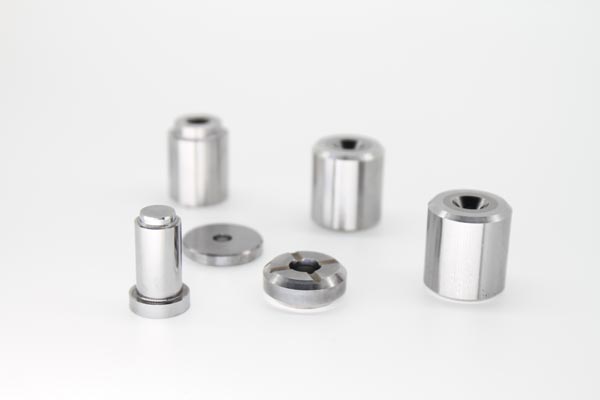
Because modern industrial processes require high precision and minimum wear, custom tungsten carbide components are widely integrated into mission-critical equipment:
- Precision Stamping Dies and Tooling: High-precision punches, die bushings, forming inserts, and stripper plates used in high-speed electrical and automotive terminal stamping.
- Medical and Semiconductor Manufacturing: Sub-micron precision cutters, nozzle components, IC packaging mold cores, and micro-punching pins.
- Industrial Wear Parts: Wire guide bushes, rotary cutters, slitting knives, and high-pressure waterjet nozzles that suffer continuous friction.
- Fluid Control and Energy Equipment: Valve seats, choke cores, plungers, and mechanical seal rings operating under extreme pressure and corrosive conditions.
Machining and Fabrication Techniques for Tungsten Carbide Components
Due to its extreme hardness, sintered tungsten carbide cannot be machined using conventional turning, milling, or drilling tools. Manufacturing tungsten carbide components to exact dimensional specifications requires specialized precision processing technologies:
- Wire Electrical Discharge Machining (Wire EDM): Utilizes spark erosion to cut complex internal geometries, narrow slots, and tight radii without imposing mechanical stress on the material.
- Optical Profile Grinding (PG / KG): Enables precise grinding of intricate 2D contours and punch profiles under optical magnification, achieving micro-level precision.
- CNC Diamond Wheel Surface & Cylindrical Grinding: Uses high-grade diamond abrasives to produce ultra-flat surfaces, tight diametrical tolerances, and smooth geometry.
- Mirror Polishing: Polishing the working surfaces of tungsten carbide components to Ra 0.02 µm or lower prevents material adhesion and friction during high-speed stamping operations.
Why Choose Yize Mould?
When procuring high-precision wear parts and mold tooling, selecting an experienced manufacturing partner is critical. Dongguan Yize Mould Co., Ltd (Yize Mould) specializes in custom precision machining for high-performance tungsten carbide components.
- Decades of Precision Expertise: Operating as a dedicated manufacturer, Dongguan Yize Mould Co., Ltd brings over 20 years of specialized manufacturing experience in working with cemented carbide alloys and complex mold hardware.
- Sub-Micron Tolerance Control: Equipped with advanced Japanese and European machinery—including Makino Wire EDM, Waida optical profile grinders, and Okamoto precision surface grinders—Yize Mould consistently achieves dimensional tolerances down to ±0.001 mm.
- Strict Quality Assurance: Quality is verified at every step. Yize Mould operates a fully equipped inspection center utilizing Zeiss CMMs, Nikon optical measurement systems, and high-precision height gauges to guarantee 100% compliance with client technical drawings.
- Tailored Material Selection: Yize Mould assists engineering teams in selecting optimal tungsten carbide grades based on operational demands, balancing toughness, wear resistance, and corrosion factors.
- Global Delivery & Service: Dongguan Yize Mould Co., Ltd supports global customers across North America, Europe, and Asia with efficient lead times, technical communication, and reliable door-to-door delivery.
Frequently Asked Questions (FAQ)
Q1: Why are tungsten carbide components preferred over hardened tool steel? Tungsten carbide components deliver substantially higher hardness (85–93 HRA compared to 60–64 HRC for hardened steel) and nearly double the rigidity. This superior wear resistance enables tungsten carbide components to maintain dimensional accuracy up to 50 times longer than tool steel under heavy continuous friction.
Q2: Can custom tungsten carbide components be produced in complex geometries? Yes. Using advanced Wire EDM, Oil-cut EDM, Optical Profile Grinding (PG), and Precision CNC Diamond Grinding, Dongguan Yize Mould Co., Ltd machines custom tungsten carbide components into complex geometries while holding tolerances to ±0.001 mm.
Q3: How does Dongguan Yize Mould Co., Ltd ensure the quality of tungsten carbide components? Dongguan Yize Mould Co., Ltd maintains strict quality control throughout the production process. Raw materials undergo density and hardness checks, and finished tungsten carbide components are inspected in a climate-controlled laboratory using CMM, optical profilers, and surface roughness testers to verify full compliance with engineering drawings.
Q4: What cobalt percentages are typically used in tungsten carbide components? Cobalt content usually varies between 6% and 15% by weight. Lower cobalt content (6%–8%) offers maximum hardness and wear resistance for micro-punching and abrasive wear parts. Higher cobalt content (10%–15%) increases fracture toughness and impact resistance, making it suitable for heavy stamping dies and cold heading tools.
 English
  Deutsch
  Français
  日本語
日本語  한국어
한국어  Español
  Português
  Italiano
  Nederlands
  Русский
  Bahasa Indonesia
  العربية