

High-Precision Inspection System for Tungsten Carbide Dies
【Introduction】In the fields of precision manufacturing and stamping, tungsten carbide dies have become core process equipment due to their superior hardness and wear resistance. However, even a micron-level deviation in die precision […]
【Introduction】
In the fields of precision manufacturing and stamping, matrices en carbure de tungstène have become core process equipment due to their superior hardness and wear resistance. However, even a micron-level deviation in die precision can lead to product scrap or a sharp drop in production efficiency. Therefore, establishing a scientific and systematic precision inspection system is not only the baseline for quality control but also the key to reducing hidden costs and enhancing corporate competitiveness. This article provides an in-depth analysis of the full-process precision inspection methods for tungsten carbide dies across four dimensions: visual inspection, geometric measurement, surface integrity, and material characteristics.
【Section 1: Visual Inspection – The First Line of Defense for Quality Control】
Although visual inspection is a qualitative analysis, it is the most efficient method for screening batch defects.
Notre activité : pièces en carbure, pièces de moule, moules d'injection médicale, moules d'injection de précision, moulage par injection de téflon PFA, raccords de tubes PFA. email : [email protected],whatsapp:+8613302615729.
- Execution Standards: Under standard light sources (e.g., D65), utilize high-magnification stereomicroscopes or industrial borescopes to perform a full-coverage scan of the die profile.
- Core Focus: Identify surface micro-cracks, pores, inclusions, and chipping. For brittle materials like tungsten carbide, microscopic surface defects can easily propagate under high-pressure conditions, leading to premature die failure.
- Personnel Requirements: Inspectors must undergo professional training and possess acute defect recognition skills to ensure objectivity and consistency in judgment.
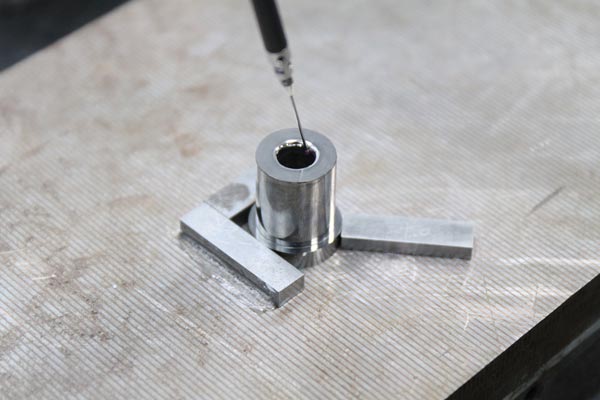
【Section 2: Geometric Precision Inspection – Micron-Level Dimensional Control】
Dimensional and form accuracy are the core hard indicators for evaluating die quality, directly determining the tolerance grade of stamped products.
- Conventional Dimensional Measurement: Utilize high-precision micrometers and the three-wire method to re-measure critical mating dimensions (such as punch diameter and die cutting edge), ensuring they remain within the design tolerance zone.
- Complex Geometric Tolerances: For tungsten carbide dies with multi-curved or micro-fine structures, a Coordinate Measuring Machine (CMM) must be introduced. By collecting point cloud data and comparing it with the CAD digital model, a chromatic deviation map is generated to accurately evaluate errors in profile, parallelism, and coaxiality.
- Imaging Assistance: For 2D precision components, a non-contact video measuring system (VMS) can be used to avoid physical damage to the die caused by contact.
【Section 3: Surface Integrity Inspection – The Key to Tribological Performance】
The surface quality of a die directly affects demolding resistance, wear resistance, and the surface finish of the workpiece.
- Roughness Quantification: Use a stylus profilometer or laser surface roughness tester to measure the Arithmetical Mean Deviation (Ra) and Maximum Height (Rz) of key profiles according to ISO standards. For precision electronic stamping dies, the Ra value usually needs to be controlled below 0.2μm.
- Profile Analysis: It is necessary not only to look at the numerical values but also to analyze waviness and texture direction to ensure the surface texture is conducive to lubricant storage and flow, reducing the risk of dry friction.
【Section 4: Material Physical Property Inspection – The Cornerstone of Service Life and Reliability】
The performance of a tungsten carbide die depends not only on its “shape” but also on its “quality.” Material property testing is a crucial basis for predicting die life.
- Hardness Distribution Testing: Use a Rockwell hardness tester (HRC) or Vickers hardness tester to conduct multi-point tests on the working area, transition zone, and substrate of the die, ensuring uniform hardness that meets process requirements (typically, cemented carbide dies require hardness ≥ HRC 85).
- Metallographic Analysis: Observe grain size, cobalt pool distribution, and porosity under a metallurgical microscope through cutting, inlaying, polishing, and etching. A uniform and fine grain structure is the microscopic foundation ensuring the die possesses both high hardness and high toughness.
【Comprehensive Application and Conclusion】
Precise inspection is not the isolated application of a single method but the cross-verification of multi-dimensional data.
In actual operation, it is recommended to follow the inspection logic of “Appearance first, then Dimensions, then Performance”: first exclude visible defects through visual inspection; lock geometric accuracy using CMM and VMS; finally evaluate long-term reliability through roughness and hardness testing.
Enterprises should establish a complete life-cycle inspection archive for dies and feedback inspection data to the processing stage to form a closed loop of “Processing – Inspection – Correction.” Only in this way can tungsten carbide dies maintain excellent stability in high-intensity production, achieving the dual maximization of product quality and economic benefits.
Articles connexes
- How to Control the Cutting Force of Tungsten Carbide Die?
- Exploring the Causes and Prevention Measures of Deformation in Tungsten Carbide Dies
- Application and Special Requirements of Tungsten Carbide Die in the Electronics Industry
- Analysis of Common Faults and Countermeasures of Tungsten Carbide Die





 English
  Deutsch
  Français
  日本語
日本語  한국어
한국어  Español
  Português
  Italiano
  Nederlands
  Русский
  Bahasa Indonesia
  العربية