

A Comprehensive Analysis of Precision Detection Methods for Tungsten Carbide Dies
I. Introduction In numerous industries such as metal processing and plastic molding, tungsten carbide dies hold a pivotal position due to their high hardness, excellent wear resistance, and outstanding thermal […]
I. Introducción
In numerous industries such as metal processing and plastic molding, tungsten carbide dies hold a pivotal position due to their high hardness, excellent wear resistance, and outstanding thermal stability. As modern manufacturing places increasingly stringent demands on product quality, the significance of precision detection for dies becomes ever more prominent. Accurate die precision detection serves as the cornerstone for ensuring high-quality products and efficient production. This article will provide an in-depth and comprehensive introduction to the precision detection methods for tungsten carbide dies, assisting readers in mastering accurate and efficient detection techniques.
II. The Importance of Precision Detection for Tungsten Carbide Dies
The precision of tungsten carbide dies has a direct and far-reaching impact on product quality and production efficiency. Any deviation in die precision can potentially lead to a series of issues, including inaccurate product dimensions, substandard surface roughness, and shape deformation. These problems not only impair product performance but also shorten its service life, resulting in economic losses for enterprises. Therefore, precision detection of tungsten carbide dies is a crucial link in ensuring stable product quality and enhancing production efficiency and should not be overlooked.
Nuestra actividad de fábrica: piezas de carburo, piezas de molde, moldes de inyección médica, moldes de inyección de precisión, moldeo por inyección de teflón PFA, accesorios de tubo PFA. correo electrónico: [email protected],whatsapp:+8613302615729.
III. Precision Detection Methods for Tungsten Carbide Dies
1. Visual Inspection Method
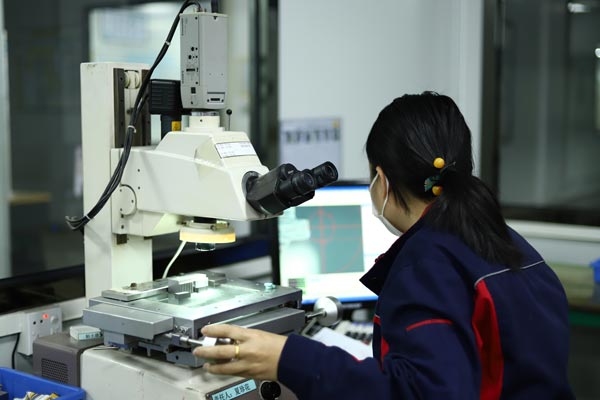
The visual inspection method is a fundamental and intuitive detection approach widely used in die inspection. It mainly involves manually observing the surface condition, dimensions, and shape of the die to preliminarily determine whether its precision meets the requirements. In practical operation, auxiliary tools such as magnifying glasses and microscopes can be employed to observe die details more clearly. This method is suitable for detecting obvious surface defects of the die, such as cracks and bubbles. However, it is difficult for visual inspection to accurately detect micro-defects inside the die and dimensional errors.
2. Precision Measurement Method
The precision measurement method utilizes professional measuring tools and equipment to precisely detect die precision. Commonly used measuring tools include vernier calipers, micrometers, and projectors. These tools can accurately measure key parameters of the die, such as dimensions, shapes, and angles, and determine whether the die precision is up to standard through detailed data analysis. The precision measurement method boasts high measurement accuracy and strong reliability, but its operation process is relatively complex. It requires professional measuring personnel with solid skills and rich experience, as well as corresponding technical support.
3. Coordinate Measuring Machine (CMM) Method
The CMM method is an automated measurement approach based on advanced computer technology. It employs a high-precision coordinate measuring machine to comprehensively detect the geometric dimensions and shapes of the die. The coordinate measuring machine features high precision, high efficiency, and a high degree of automation. It can quickly and accurately acquire three-dimensional data of the die and conduct in-depth analysis through professional software to determine whether the die precision meets the design requirements. This method is particularly suitable for occasions with extremely high die precision requirements, such as automobile manufacturing and aerospace.
4. Ultrasonic Testing Method
The ultrasonic testing method detects internal defects of the die by utilizing the propagation characteristics of ultrasonic waves in materials. During detection, an ultrasonic probe is placed on the die surface. Ultrasonic waves propagate and reflect within the material, and by analyzing the reflected signals, internal cracks, pores, and other defects of the die can be detected. The ultrasonic testing method offers advantages such as non-contact, non-destructive, and a wide detection range, enabling the discovery of micro-defects inside the die. However, its operation is relatively complex and requires professional equipment and trained personnel.
5. Magnetic Particle Testing Method
The magnetic particle testing method detects surface and near-surface defects of the die by utilizing the special behavior of magnetic particles in a magnetic field. After applying a magnetic field to the die surface, magnetic particles will accumulate at the defect sites to form magnetic traces, clearly revealing surface cracks, pores, and other defects of the die. The magnetic particle testing method has advantages such as high detection sensitivity and simple operation, but it is only applicable to dies made of ferromagnetic materials.
IV. Precautions for Precision Detection of Tungsten Carbide Dies
- Select the Appropriate Detection Method: When conducting precision detection of tungsten carbide dies, it is necessary to choose the most suitable detection method based on the specific characteristics, precision requirements, and detection conditions of the die, and make flexible adjustments and optimizations according to the actual situation.
- Ensure the Accuracy and Reliability of Measuring Tools: When using professional measuring tools and equipment, it is crucial to ensure their accuracy and reliability. Regularly calibrate and maintain the measuring tools and strictly follow the correct operation methods and procedures during detection to ensure the accuracy of measurement results.
- Closely Observe the Die Status: During the detection process, pay close attention to the surface condition and dimensional changes of the die. Once any abnormalities are detected, take timely measures to deal with them to prevent the problems from escalating.
- Pay Attention to Die Protection: When detecting the precision of the die, operate carefully to avoid causing damage or deformation to the die’s surface and internal structure. Appropriate protective measures can be adopted, such as using soft pads and avoiding excessive force.
- Conduct Thorough Data Analysis: After completing the detection, carefully organize and conduct in-depth analysis of the detection data. Based on the analysis results, determine whether the die precision meets the requirements. If not, formulate scientific and reasonable treatment measures according to the actual situation.
V. Conclusión
Precision detection of tungsten carbide dies is a core link in ensuring product quality and production efficiency. By scientifically and reasonably selecting detection methods, strictly adhering to correct operation procedures, attaching great importance to die protection, and conducting thorough detection data analysis, accurate and efficient precision detection of tungsten carbide dies can be achieved, providing solid and reliable guarantees for product quality and production efficiency. In practical applications, enterprises should flexibly select appropriate detection methods according to their specific needs and actual situations and continuously optimize and improve them to meet the strict precision requirements of different fields for dies.
FAQ
Q1: Can the visual inspection method detect all internal defects of the die?
A1: The visual inspection method is mainly suitable for detecting obvious surface defects of the die. Due to the inability of direct visual observation to reach the interior of the die, it is difficult to accurately detect micro-defects and dimensional errors inside the die.
Q2: Is the CMM method suitable for the precision detection of all types of tungsten carbide dies?
A2: Although the CMM method has many advantages, it is not suitable for the precision detection of all types of tungsten carbide dies. For dies with simple structures and low precision requirements, other simpler detection methods may be more appropriate; while for complex dies with extremely high precision requirements, the CMM method can fully demonstrate its advantages.
Q3: Can the ultrasonic testing method and the magnetic particle testing method be used simultaneously?
A3: The ultrasonic testing method is mainly used for detecting internal defects of the die, and the magnetic particle testing method is suitable for detecting surface and near-surface defects of ferromagnetic material dies. The focuses of the two detection methods are different. In some cases, to comprehensively understand the defect situation of the die, these two methods can be used simultaneously, but it depends on the material of the die and specific detection requirements.
Entradas relacionadas
- A Professional Guide to Selecting Tungsten Carbide Die Cleaning Agents
- Application and Remarkable Characteristics of Tungsten Carbide Dies in the Electronics Industry
- Tungsten Carbide Die Coating Technology: Analysis of Functions and Detailed Introduction of Types
- How to Accurately Choose the Cooling Method for Tungsten Carbide Dies


 English
  Deutsch
  Français
  日本語
日本語  한국어
한국어  Español
  Português
  Italiano
  Nederlands
  Русский
  Bahasa Indonesia
  العربية