

Industrial Carbide Nozzles: Selection, Performance and Supply
Introduction A nozzle looks like the cheapest part on the line, yet it determines how the whole process runs. Spray uniformity, media consumption, part quality and unplanned downtime all trace […]
Introducción
A nozzle looks like the cheapest part on the line, yet it determines how the whole process runs. Spray uniformity, media consumption, part quality and unplanned downtime all trace back to a bore only a few tenths of a millimetre wide. Industrial carbide nozzles, pressed and sintered from cemented tungsten carbide (WC-Co), exist for one reason: steel erodes, ceramics crack, and both fail sooner than a production line can afford.
Nuestra actividad de fábrica: piezas de carburo, piezas de molde, moldes de inyección médica, moldes de inyección de precisión, moldeo por inyección de teflón PFA, accesorios de tubo PFA. correo electrónico: [email protected],whatsapp:+8613302615729.
This guide is written from the shop floor, not from a product catalogue. It covers what carbide nozzles do well, which design variables actually determine performance, how to specify them, and how to assess a carbide nozzle manufacturer before committing to a volume order.
What Industrial Carbide Nozzles Are
An industrial carbide nozzle is a wear part made from tungsten carbide powder, usually with a 6–12% cobalt binder. The powder is consolidated by pressing and sintering — often with hot isostatic pressing — and then diamond-ground, EDM-machined or lapped to its final bore and geometry. The result is a nozzle with hardness in the HRA 88–92 range that holds its internal profile under abrasive media, high pressure and thermal cycling.
Three characteristics matter more than the headline hardness figure:
- Erosion resistance. In grit blasting, slurry handling and descaling duty, carbide outlasts hardened steel by a wide margin, so the replacement interval stops driving maintenance schedules.
- Dimensional stability. The bore does not creep, bell out or round off in service. Flow rate at day 300 stays close to flow rate at day one, which is what keeps coating thickness and blasting intensity repeatable.
- Machining capability. Carbide can be ground to sub-0.01 mm bore tolerances with fine surface finish, which is what makes a controlled spray angle possible in the first place.
Why Carbide Rather Than Steel, Ceramic or Sapphire
Hardened steel nozzles are inexpensive and easy to source, but abrasion removes material from the bore quickly. As the bore grows, flow rate rises and the spray pattern drifts, so operators compensate with pressure changes that make the process harder to control.
Ceramic nozzles resist wear well and are lighter, but they are brittle. Thermal shock, a dropped nozzle or an angled impact in a blast cabinet can end their service life without warning.
Sapphire and diamond offer excellent wear resistance in fine-orifice water jet and precision spray work, at a cost per piece that only makes sense where the orifice is very small and the media is clean. Where media is abrasive and pressures are high, cemented tungsten carbide remains the balanced choice: tough enough to survive handling and impact, hard enough to hold its geometry, and repairable or re-grindable in some geometries.
Design Variables That Decide Performance
Bore geometry and flow rate. Flow through a nozzle scales roughly with the square of the bore diameter. A 10% increase in bore size raises flow by about 20%, which is why tolerance on the bore, not tolerance on the outside diameter, is the specification that matters. Inlet-to-outlet ratio, taper angle and straight-land length together decide whether the jet stays coherent or spreads.
Carbide grade. Coarse-grain grades with higher cobalt content absorb impact and are suited to shot peening and harsh blasting. Fine and submicron grades give a smoother bore, better surface finish and stronger resistance to fine-particle erosion, which suits precision spray and high-pressure descaling.
Bore surface finish. A lapped bore in the Ra 0.1–0.2 µm range removes the surface irregularities where erosion starts. It also keeps flow coefficient stable over the service interval.
Connection and alignment. Thread standard, clamping method and concentricity with the upstream pipe all affect spray symmetry. A perfectly ground bore misaligned by a few tenths of a millimetre will still produce an uneven pattern.
Internal features. Steps, multiple orifices, air caps and integrated strainers change both flow behaviour and maintenance practice, and they need to be defined at the drawing stage rather than added later.
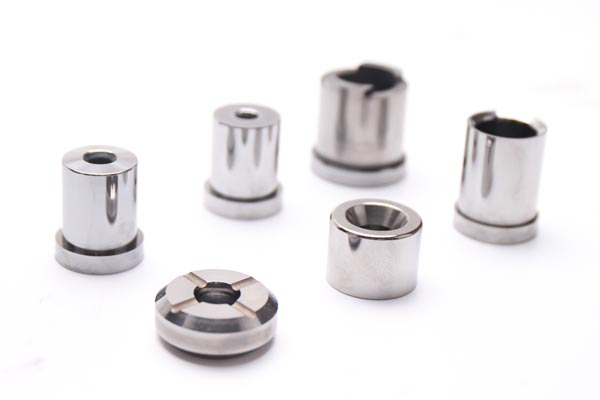
Where Industrial Carbide Nozzles Are Used
- Surface preparation. Grit blasting nozzles, blast cabinet venturis and shot peening nozzles, where abrasive media constantly erodes the bore.
- Steel and metal processing. High-pressure descaling nozzles that strip oxide scale at pressures where steel nozzles lose their profile in weeks.
- Oil and gas. Drill bit nozzles, choke and flow-control orifices exposed to sand-laden fluids and severe erosion.
- Mining and mineral processing. Slurry spray nozzles for dust suppression, washing and froth handling.
- High-pressure cleaning and water jet work. Orifices and focusing elements that must hold a precise, stable jet.
- Coating and thermal spray. Nozzles and air caps where consistent atomisation determines coating uniformity.
How Quality Is Built: From Powder to Finished Bore
A carbide nozzle is only as good as the process behind it. Reputable production follows a fixed sequence: incoming powder verification for grain size and chemistry, controlled pressing to avoid density gradients, sintering or sinter-HIP to close residual porosity, then diamond grinding, EDM and lapping for the bore.
Inspection is where suppliers differentiate themselves. Air gauging confirms bore diameter; a coordinate measuring machine checks geometry and concentricity; a flow bench verifies flow rate against the rated pressure; hardness and metallographic checks confirm grade and microstructure. Batch traceability from powder lot to finished part is standard practice in serious shops, and it is the first thing to ask for when a nozzle fails in the field.
What to Put on the RFQ
A clear enquiry shortens lead time more than any negotiation:
- Bore size with tolerance, and the spray pattern required — solid cone, hollow cone, flat fan, straight jet.
- Carbide grade or the operating condition the grade must survive.
- Thread or connection standard, and overall envelope dimensions.
- Rated flow at a stated pressure, and the fluid or media involved.
- Surface finish requirement for the bore.
- Expected service life or current replacement frequency.
- Documentation and inspection requirements, plus sample quantity before volume release.
Total Cost of Ownership
Unit price is a poor guide for a wear part. The real cost is the nozzle plus the labour to change it, the downtime it causes, and the scrap produced when flow drifts out of specification. If a nozzle change stops a line for two hours, a 30% premium on the part is rarely the deciding number; the deciding number is how many changes the plant avoids in a year. This is why buyers who run abrasive processes tend to standardise on one carbide nozzle manufacturer and one grade, then manage life by measurement rather than by guesswork.
Choosing a Carbide Nozzle Manufacturer
Five questions separate a manufacturer from a trader:
- Is carbide pressing, sintering and bore finishing done in-house, or subcontracted without process control?
- What bore tolerance and repeatability can be held across a batch, not just on a sample?
- Can inspection data — bore, flow, hardness, microstructure — be supplied with each lot?
- Is application engineering available, so grade and geometry are matched to the media rather than chosen from a list?
- What is the realistic lead time for repeat orders, and how is consistency maintained between them?
A supplier who answers these with documents rather than assurances is usually the one worth a trial order. Start with samples under real operating conditions, measure bore growth over the first service interval, and let the data decide the volume contract.
Conclusión
Industrial carbide nozzles are a small component with an outsized effect on process stability. The specification that matters is the bore: its size, tolerance, finish and the grade around it. Get those right, verify them with inspection data, and the nozzle stops being a maintenance item and becomes a controlled variable. That is the difference a capable carbide nozzle manufacturer brings — not a catalogue of sizes, but a process that repeats.
Frequently Asked Questions
What is the difference between a carbide nozzle and a ceramic nozzle? Carbide nozzles are tougher and resist impact and thermal cycling better, which suits abrasive blasting, descaling and field service. Ceramic nozzles are lighter and wear-resistant but brittle, and they are usually preferred where the nozzle is fixed, protected and handling is minimal.
How long do industrial carbide nozzles last? Service life depends on media, pressure and duty cycle rather than on a single figure. In abrasive blasting and slurry service, carbide typically lasts several times longer than hardened steel. The practical approach is to measure bore growth at fixed intervals and replace on flow deviation, not on calendar time.
Can carbide nozzles be manufactured to a custom drawing? Yes. Custom geometries, non-standard threads, multi-orifice patterns and specific carbide grades are routinely produced to drawing. Provide bore tolerance, flow rate at rated pressure and the operating media, and the manufacturer can propose the grade and finishing route.
What bore tolerances are achievable in tungsten carbide? Typical production tolerances sit in the range of ±0.01 mm on bore diameter, with tighter control achievable on fine bores using lapping and air gauging. Surface finish in the Ra 0.1–0.2 µm range is realistic for precision spray and descaling nozzles.
Do carbide nozzles suit abrasive slurry and high-pressure service? They are specifically designed for it. Fine-grain grades with good binder balance resist fine-particle erosion at high pressure, while coarser grades handle impact from larger media. Grade selection, not nozzle shape alone, decides how well the part performs.
Can worn carbide nozzles be reconditioned? In some geometries, yes. Bores can be re-lapped or re-ground where wall thickness allows, and the part returned to specification. Reconditioning is worth evaluating for large or complex nozzles, but for small standard parts replacement is usually more economical.


 English
 Deutsch
 Français
 日本語
 한국어
 Español
 Português
 Italiano
 Nederlands
 Русский
 Bahasa Indonesia
 العربية