

What Are the Common Methods for Tungsten Carbide Mold Precision Inspection
Tungsten carbide molds, with their exceptional hardness and wear resistance, play an irreplaceable role in modern precision manufacturing. Mold accuracy directly determines the machining quality and production efficiency of end […]
Tungsten carbide molds, with their exceptional hardness and wear resistance, play an irreplaceable role in modern precision manufacturing. Mold accuracy directly determines the machining quality and production efficiency of end products. Therefore, precision inspection is a critical step in ensuring stable mold performance and improving product yield. This article systematically reviews the mainstream methods for tungsten carbide mold precision inspection, serving as a reference for industry practitioners.
I. Visual Inspection
Visual inspection is the most basic and intuitive inspection method, primarily relying on the naked eye or a magnifying glass to observe mold surface quality, dimensional tolerances, and form tolerances for a preliminary assessment of whether mold accuracy meets requirements. This method is simple to operate and extremely low in cost. However, it is limited by human visual resolution and subjective experience, offering limited capability in identifying minor defects or subtle deviations. It is typically used only as a preliminary screening tool and should not serve as the sole basis for final judgment.
Nuestra actividad de fábrica: piezas de carburo, piezas de molde, moldes de inyección médica, moldes de inyección de precisión, moldeo por inyección de teflón PFA, accesorios de tubo PFA. correo electrónico: [email protected],whatsapp:+8613302615729.
II. Precision Instrument Inspection
Precision instrument inspection utilizes tools such as vernier calipers, micrometers, dial indicators, internal micrometers, and height gauges to measure mold dimensions, form, and positional tolerances point by point, yielding specific numerical results. This method offers relatively high accuracy and reliable outcomes, making it suitable for precise verification of conventional dimensions. However, it demands a high level of professional skill from operators, and the point-by-point measurement process is relatively time-consuming, making it more appropriate for single-piece or small-batch inspection scenarios.
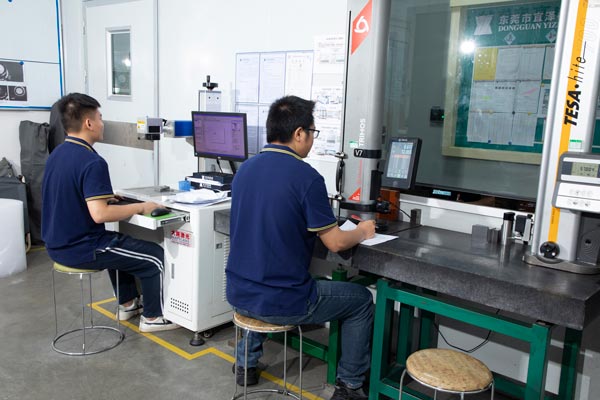
III. Coordinate Measuring Machine (CMM) Inspection
The coordinate measuring machine (CMM) is the core equipment in current mold precision inspection. Using high-precision grating scales or laser interferometers, it collects three-dimensional coordinate data from points across the mold surface, enabling comprehensive evaluation of dimensional accuracy, geometric tolerances, and profile deviations. This method achieves micron-level accuracy with high efficiency and a high degree of automation, making it especially suitable for full-dimension inspection of complex curved surfaces and high-precision molds. Its main limitations lie in the high acquisition and maintenance costs of the equipment, as well as the advanced technical skills required of operators.
IV. Laser Scanning Inspection
Laser scanning inspection uses a laser scanner to perform non-contact, rapid scanning of the mold surface, acquiring high-density three-dimensional point cloud data. This data is then compared against the theoretical model to determine overall accuracy deviations. This method offers the advantages of fast measurement speed, wide coverage, and non-contact, non-destructive testing, making it particularly suitable for full-dimension inspection of large molds and complex free-form surfaces. It should be noted that scanning accuracy is affected by resolution and scanning angle, and post-scanning data correction and error compensation are required.
V. Ultrasonic Inspection
Ultrasonic inspection leverages the propagation and reflection characteristics of ultrasonic waves within materials to detect internal defects such as micro-cracks, porosity, and inclusions in tungsten carbide molds, while also assisting in the assessment of internal dimensional accuracy. As a non-destructive testing method, it offers high sensitivity and excellent efficiency, capable of uncovering internal issues that conventional instruments cannot reach. However, its results are significantly influenced by material density, wall thickness, and surface condition, requiring careful selection of probe frequency and inspection parameters based on specific conditions.
VI. Other Supplementary Inspection Methods
In addition to the above mainstream methods, X-ray inspection and industrial CT scanning have also been increasingly applied to precision and defect inspection of tungsten carbide molds. X-ray is suitable for rapid internal structure visualization, while CT scanning enables three-dimensional non-destructive reconstruction of the mold interior. Each has its own applicable scenarios and can be flexibly selected according to specific inspection requirements.
VII. Key Considerations for Precision Inspection
The value of precision inspection lies not only in identifying problems but also in providing a reliable basis for subsequent repair and process optimization. In practice, the following four aspects should be prioritized:
First, select the inspection method appropriately. Match the most suitable inspection approach based on mold structural complexity, accuracy grade, and inspection purpose, avoiding both over-inspection and under-inspection.
Second, strictly adhere to inspection standards. All inspection operations should be conducted in accordance with relevant national standards or industry specifications to ensure compliance and traceability of results.
Third, maintain thorough records and reports. Fully archive the inspection process, raw data, and conclusions to facilitate subsequent quality analysis and continuous improvement.
Fourth, close the loop promptly. Any deviations or defects identified during inspection should be addressed immediately with a repair plan and corrective actions, preventing defective molds from entering the production line.
VIII. Conclusión
Tungsten carbide mold precision inspection is a core process for ensuring mold quality and end-product quality. From visual screening to CMM full inspection, from laser scanning to ultrasonic flaw detection, each method has its own applicable boundaries and technical advantages. Enterprises should establish a reasonable inspection system based on their own product accuracy requirements and production capacity, driving continuous improvement in mold manufacturing through scientific means.
FAQ
Q1: For tungsten carbide mold precision inspection, how should one choose between a CMM and laser scanning?
If high-precision numerical values for individual points are needed and the mold structure is relatively regular, the CMM should be prioritized. If rapid acquisition of overall deviation distribution across complex curved surfaces is required, laser scanning offers greater efficiency. The two can also be used in combination to complement each other and enhance inspection completeness.
Q2: Since visual inspection has low accuracy, is it still necessary to retain?
Yes. Visual inspection is the lowest-cost first line of defense, capable of quickly ruling out obvious surface damage such as scratches and chipping. Conducting a visual pre-screening before formal measurement effectively reduces wasted effort in subsequent precision inspection.
Q3: Can ultrasonic inspection replace a CMM for dimensional accuracy measurement?
No. The core strength of ultrasonic inspection lies in detecting internal defects, and its capability for measuring external dimensional accuracy is limited. Precise verification of dimensions and geometric tolerances still requires a CMM or high-precision instruments.


 English
  Deutsch
  Français
  日本語
日本語  한국어
한국어  Español
  Português
  Italiano
  Nederlands
  Русский
  Bahasa Indonesia
  العربية