

Carbide Grinding: The Complete Guide to Precision-Grinding Tungsten Carbide Components
Tungsten carbide components are the backbone of modern tooling, wear protection, and precision engineering. Yet their extreme hardness and low thermal conductivity make them among the most difficult materials to […]
Tungsten carbide components are the backbone of modern tooling, wear protection, and precision engineering. Yet their extreme hardness and low thermal conductivity make them among the most difficult materials to machine. Carbide grinding is not a generic finishing step—it is a specialized discipline that determines whether a component meets its dimensional tolerance, surface finish, and service life. This guide explains how professional manufacturers approach carbide grinding, from process selection and wheel specification to coolant management, defect prevention, and quality control.
Why Tungsten Carbide Components Demand Specialized Grinding
Tungsten carbide (WC) is a cemented composite of tungsten carbide grains bonded by a metallic binder, typically cobalt. It delivers hardness in the range of 88 to 93 HRA and wear resistance far beyond that of tool steel, which is why it is used for cutting inserts, dies, seal rings, nozzles, and wear parts across industries.
Notre activité : pièces en carbure, pièces de moule, moules d'injection médicale, moules d'injection de précision, moulage par injection de téflon PFA, raccords de tubes PFA. email : [email protected],whatsapp:+8613302615729.
After sintering, components are formed near net shape but rarely meet final specifications. Sintering shrinkage, distortion, and surface condition all leave the component short of the tolerances required for assembly and function. Carbide grinding is the operation that bridges that gap: it removes the sintered skin, corrects geometry, and generates the precise dimensions and surface quality the application demands. Because the material is harder than every conventional abrasive, carbide grinding relies on diamond wheels, which remain the only practical abrasive capable of efficiently removing tungsten carbide.
Core Carbide Grinding Processes
Different geometries call for different grinding strategies. The most common carbide grinding operations include:
Surface grinding produces flat, parallel faces on carbide plates, blocks, and workpieces, and is widely used for seal faces and wear plates where flatness is critical.
Cylindrical grinding machines the outside diameters of carbide shafts, rollers, and bushings, achieving high roundness and close diameter tolerances.
Centerless grinding handles small-diameter carbide rods and pins in high volume, using a regulating wheel to control feed without a spindle center.
Creep feed grinding removes substantial stock in a single slow pass with a deep cut, making it ideal for complex profiles, flutes, and stepped geometries in cutting tool manufacture.
Tool and cutter grinding resharpens carbide end mills, drills, and inserts, where edge quality directly dictates cutting performance.
Selecting the right process depends on the component geometry, production volume, and the tolerance and finish required. Most shops combine processes: rough carbide grinding for stock removal followed by fine grinding to establish final dimensions.
Selecting the Right Diamond Grinding Wheel
Wheel selection is the single most influential decision in carbide grinding. The abrasive must be diamond, but the bond system, grit size, and concentration determine how the wheel behaves.
Resin-bonded diamond wheels are the most versatile choice for carbide grinding. They cut cool, deliver excellent surface finishes, and are well suited to both stock removal and finishing. For most standard applications they offer the best balance of performance and cost.
Metal-bonded diamond wheels are aggressive and long-lasting, making them the preferred option for heavy stock removal and creep feed grinding. They hold their form well but generate more heat and require careful coolant management.
Vitrified-bonded diamond wheels offer high precision and exceptional form-holding ability, which makes them valuable for grinding complex profiles and tight-tolerance features.
Grit size follows the operation: coarse grits (60 to 120 mesh) for rapid stock removal, medium grits (180 to 320) for general grinding, and fine grits (400 to 800 or finer) for finishing and edge quality. Wheel concentration, typically 75 to 125, should be matched to the operation—higher concentrations resist wear during heavy grinding, while lower concentrations cut freer and cooler for finishing.
The wheel must also be dressed correctly before carbide grinding. Dressing exposes fresh abrasive and corrects wheel shape; a dull or loaded wheel generates excess heat and produces poor results regardless of the other parameters.
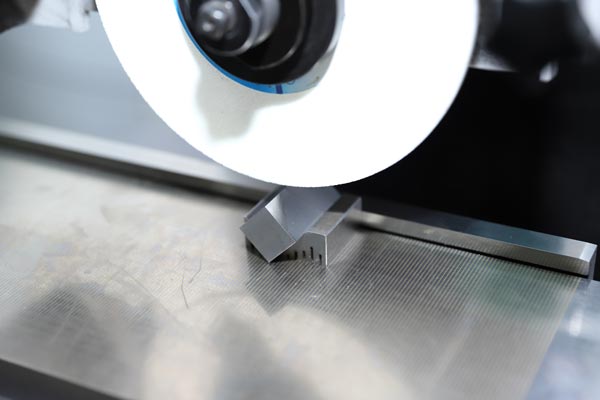
Optimizing Grinding Parameters for Carbide Grinding
Tungsten carbide is brittle and heat-sensitive, so carbide grinding parameters must be conservative by design. The goal is to remove material efficiently while keeping the temperature at the grinding zone low enough to protect both the cobalt binder and the component’s surface integrity.
Wheel speed should be matched to the bond system and machine capability, generally in the range of 25 to 40 meters per second for resin-bonded wheels. Depth of cut is kept modest for conventional carbide grinding—typically 0.01 to 0.05 mm per pass for finishing—while creep feed grinding uses deep cuts at slow feed rates to remove stock in one controlled pass. Feed rates should be steady and consistent; dwell time at the end of a pass should be minimized to prevent localized overheating.
Consistent parameters matter as much as correct ones. In production carbide grinding, variations in speed, feed, or spark-out time show up directly in dimensional scatter, surface roughness, and edge quality. Documented, repeatable process settings are the foundation of consistent output.
Coolant Management: The Key to Defect-Free Carbide Grinding
No aspect of carbide grinding is more neglected and more consequential than coolant. Tungsten carbide conducts heat poorly compared with steel, so virtually all the heat generated during grinding stays concentrated at the contact zone. Without effective cooling, that heat damages the component and the wheel.
Flood coolant delivered through nozzles aimed directly at the grinding zone is standard practice, with soluble oil or synthetic grinding fluids formulated for carbide. Coolant pressure and flow must be sufficient to penetrate the air barrier around the wheel—high-pressure delivery of 10 bar or more is increasingly common for aggressive carbide grinding operations. Filtration is equally important: because diamond grit and carbide particles are highly abrasive, unfiltered coolant recirculates fines into the grinding zone, degrading finish and shortening wheel life.
Temperature control is not only about finish. Excessive heat depletes or redistributes the cobalt binder near the ground surface, a condition known as cobalt depletion, which leaves the surface brittle and prone to premature failure in service. Effective cooling preserves the surface structure and the component’s mechanical integrity.
Common Defects in Carbide Grinding and How to Prevent Them
Even experienced shops encounter defects in carbide grinding. The most common failure modes are well understood, and each has a clear preventive strategy.
Edge chipping occurs when brittle edges break during grinding. It is typically caused by excessive feed, a worn or dull wheel, insufficient coolant, or heavy spark-out at the edge. Prevention starts with sharp, properly dressed wheels, reduced feed at final passes, and chamfering or pre-rounding edges where possible.
Micro-cracks and thermal damage develop when grinding heat builds up beyond the material’s tolerance. The result is a network of fine cracks visible only under magnification, which later propagate under load. Controlled wheel speeds, smaller depth of cut, and reliable coolant delivery are the primary defenses.
Grinding burn appears as discoloration on the ground surface, evidence that localized temperature exceeded acceptable limits. Burn is almost always a coolant or parameter problem: improve coolant delivery, reduce depth of cut, or increase wheel speed within the wheel’s operating range.
Cobalt depletion weakens the surface layer and undermines wear resistance. It is best prevented at the process level, through heat control and appropriate finishing passes that remove any thermally damaged layer.
Poor edge definition and waviness usually trace back to wheel wear, machine rigidity, or fixture deflection. Regular wheel dressing, rigid workholding, and consistent spark-out cycles resolve most of these issues.
Quality Control in Carbide Grinding
Precision carbide grinding exists to deliver measurable results, and those results must be verified. Dimensional tolerances in carbide grinding commonly run to plus or minus 0.005 mm, and demanding applications call for tighter control. Surface finish of Ra 0.1 to 0.4 micrometers is routinely achievable with fine-grit wheels and proper process conditions, with mirror finishes possible for seal faces and similar applications.
Verification combines in-process and final inspection. Coordinate measuring machines confirm critical dimensions, while surface profilometers measure finish. Edge quality and surface integrity are checked visually under magnification, and, for critical components, metallurgical examination verifies that the ground surface is free of cracks, burn, and cobalt depletion. Roundness, flatness, and parallelism are measured against the component’s functional requirements rather than a one-size-fits-all standard.
Applications of Precision-Ground Tungsten Carbide Components
The value of controlled carbide grinding is visible across industries. Cutting tools—end mills, drills, inserts, and reamers—depend on precisely ground geometries and edges for performance. Wear parts such as dies, punches, guide plates, and seal rings rely on ground surfaces for dimensional accuracy and long service life in abrasive environments. Nozzles and valve components require tight bores and smooth finishes for consistent flow control. In the medical sector, carbide instruments are ground to exacting finishes that must meet stringent standards. In every case, the ground surface is not cosmetic; it is functional, and it is produced only through disciplined carbide grinding practice.
Conclusion
Carbide grinding transforms sintered tungsten carbide components into precision-engineered parts that perform reliably under demanding conditions. Success depends on four fundamentals: the right diamond wheel for the operation, conservative and repeatable process parameters, rigorous coolant and thermal management, and systematic quality control. Manufacturers who master these fundamentals achieve tighter tolerances, longer tool life, fewer defects, and lower overall cost per part. For buyers and engineers evaluating carbide grinding capability, these are precisely the questions worth asking: what wheel system is used, how coolant is managed, how defects are prevented, and how quality is verified.
Frequently Asked Questions
Why must tungsten carbide be ground with diamond wheels?
Tungsten carbide is harder than conventional abrasives such as aluminum oxide and silicon carbide, so only diamond can efficiently cut it. Diamond wheels also produce the fine finishes and tight tolerances that carbide components require.
What surface finish can carbide grinding achieve?
With fine-grit diamond wheels and controlled process parameters, carbide grinding routinely achieves surface finishes of Ra 0.1 to 0.4 micrometers, and mirror finishes are possible for critical seal faces and similar applications.
Can tungsten carbide be ground without coolant?
Dry carbide grinding is strongly discouraged. Because tungsten carbide conducts heat poorly, dry grinding causes rapid temperature buildup that leads to burn, micro-cracking, and cobalt depletion. Flood or high-pressure coolant is essential for defect-free results.
How do you prevent edge chipping when grinding carbide?
Use a sharp, properly dressed diamond wheel, keep feeds moderate, maintain full coolant coverage, and avoid heavy spark-out at edges. Pre-chamfering vulnerable edges and finishing with lighter passes also reduce chipping risk.
What is the difference between creep feed and conventional carbide grinding?
Conventional carbide grinding uses shallow cuts and multiple passes to remove stock, while creep feed grinding removes material in one deep, slow pass. Creep feed is more efficient for complex profiles and flutes, but it generates more heat and demands robust coolant delivery.
How does grinding affect the surface integrity of tungsten carbide?
Poorly controlled grinding heat can deplete the cobalt binder at the surface, creating a brittle, weakened layer that fails prematurely in service. Proper coolant management and finishing passes preserve the surface structure and ensure the component performs as designed.
Articles connexes
- Carbide EDM Machining: Precision Electrical Discharge Machining for Tungsten Carbide Parts
- CNC Machining Tungsten Carbide: Precision Solutions for Industrial Excellence
- Precision Carbide Machining Process: Advanced Methods and Industrial Standards
- Carbide vs Ceramic Materials: A Comprehensive Guide to Wear Resistant Materials




 English
  Deutsch
  Français
  日本語
日本語  한국어
한국어  Español
  Português
  Italiano
  Nederlands
  Русский
  Bahasa Indonesia
  العربية