
Carbide EDM Machining: Precision Electrical Discharge Machining for Tungsten Carbide Parts
Carbide EDM machining has become the preferred manufacturing method for producing high-precision tungsten carbide components that conventional cutting cannot deliver. From stamping dies and mold inserts to wear parts and […]
Carbide EDM machining has become the preferred manufacturing method for producing high-precision tungsten carbide components that conventional cutting cannot deliver. From stamping dies and mold inserts to wear parts and cutting tools, electrical discharge machining (EDM) lets manufacturers machine the hardest materials with burr-free edges, tight tolerances, and complex geometries. This article explains how carbide EDM machining works, why it is essential for tungsten carbide parts, the benefits it offers, and the best practices that ensure consistent, cost-effective results.
What Is Carbide EDM Machining?
Carbide EDM machining is the process of removing material from cemented carbide—commonly tungsten carbide (WC-Co)—using controlled electrical discharges, or sparks. Cemented carbide consists of hard tungsten carbide grains bonded by a metallic binder, typically cobalt. This structure gives the material exceptional hardness (often 85–93 HRA), compressive strength, and wear resistance, which makes it ideal for tooling and wear-critical applications.
Onze fabriek business: carbide onderdelen, schimmel onderdelen, medische spuitgietmatrijzen, precisie spuitgietmatrijzen, teflon PFA spuitgieten, PFA buismontage. e-mail: [email protected],whatsapp:+8613302615729.
EDM does not rely on mechanical cutting force. Instead, a series of rapid electrical discharges between an electrode and the workpiece erodes tiny amounts of material through localized melting and vaporization. Because the process depends on electrical conductivity rather than hardness, it can machine carbide grades that would quickly destroy conventional milling or turning tools.
Why Carbide Components Demand EDM
Tungsten carbide is one of the most difficult materials to machine, and this is precisely why EDM is so widely used for it.
- Extreme hardness: Carbide grades routinely exceed the hardness of most cutting tool materials, making conventional machining impractical or impossible without severe tool wear.
- Brittleness: Carbide is hard but brittle. Mechanical cutting can cause edge chipping, cracking, and micro-fractures, especially on thin sections or intricate features.
- Complex geometries: Grinding can achieve fine finishes, but it struggles with deep cavities, small corner radii, angled features, and internal contours.
- Hardness-independent material removal: EDM removes material by thermal erosion, so material hardness is irrelevant as long as the part is electrically conductive—which makes carbide an excellent EDM workpiece.
For these reasons, carbide EDM machining is the standard route for punches, dies, mold inserts, extrusion dies, and precision wear parts.
The Main EDM Processes for Carbide
Wire EDM (WEDM) for Carbide
Wire electrical discharge machining uses a thin brass, copper, or molybdenum wire as the electrode. The wire cuts through the carbide blank along a programmed path, making it ideal for through-cut profiles, blanks, and external contours.
Wire EDM is widely used for carbide because it delivers excellent straightness, tight tolerances, and smooth sidewalls. It is the process of choice when producing carbide inserts, punches, and die blanks from solid stock, with typical tolerances in the range of ±0.002–0.005 mm depending on the machine, wire diameter, and cutting strategy.
Sinker (Ram) EDM for Carbide
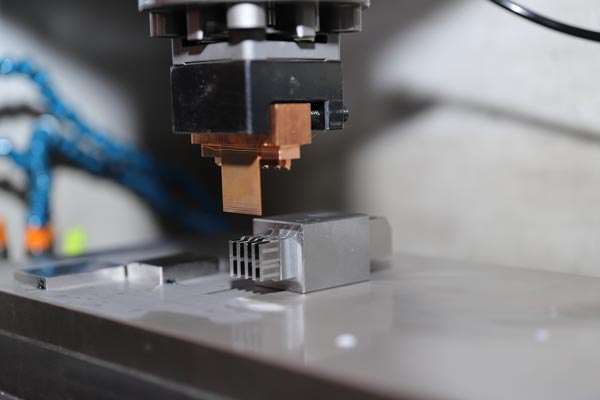
Sinker EDM uses a shaped electrode—usually copper or graphite—that is plunged into the workpiece to create blind cavities, pockets, and complex three-dimensional forms. This makes it essential for carbide mold inserts, stamping dies, and tooling with internal features that wire EDM cannot reach.
Sinker EDM on carbide requires careful control of discharge energy to avoid surface damage and is frequently combined with finish passes to achieve the required surface roughness and dimensional accuracy.
EDM Hole Drilling for Carbide
Small-hole EDM drilling is used to produce cooling holes, vent holes, and start holes in carbide components. It is especially valuable in injection molds and die applications where precise, burr-free holes are required in locations that are difficult to access by any other method.
Key Benefits of Carbide EDM Machining
- Hoge precisie: Carbide EDM machining holds tight tolerances consistently, often within ±0.002–0.005 mm for wire-cut features and comparable results on sinker work.
- Burr-free edges: Thermal erosion leaves clean edges without burrs, eliminating secondary deburring operations.
- No mechanical stress: Because no cutting force is applied, thin-walled and delicate carbide sections can be machined without distortion or breakage.
- Complex geometry capability: Deep cavities, sharp internal corners, small holes, and intricate profiles are all achievable.
- Excellent surface finish: Finish passes can produce surface roughness down to Ra 0.2–0.4 µm or better, ready for polishing or coating.
- Material flexibility: The same process handles fine-grain, sub-micron, and cobalt-rich carbide grades without retooling.
- High repeatability: Once programmed, carbide EDM machining reproduces identical parts across large batches, supporting serial production.
Common Applications of EDM-Machined Carbide Parts
Carbide components produced by EDM serve demanding roles across many industries:
- Tool and die making: Stamping punches, dies, and die sets.
- Injection molding: Mold inserts, cores, cavities, and cooling inserts.
- Wear parts: Nozzles, guides, bushings, valve seats, and flow-control components.
- Cutting tools: Drills, end mills, and indexable inserts requiring precise edges and rake faces.
- Medical devices: Surgical instruments and orthopedic cutting tools where sharpness and biocompatible finishes matter.
- Aerospace and automotive: Precision tooling, fuel system components, and high-wear mechanical parts.
Challenges in Carbide EDM Machining and How to Control Them
EDM is not without its challenges when applied to carbide. Understanding them is the key to achieving reliable results.
Cobalt Binder Depletion and Recast Layer
The spark creates a thin recast layer on the machined surface. In carbide, the high temperatures can deplete cobalt from the surface zone, leaving a weakened, cobalt-depleted layer that reduces edge hardness and fatigue resistance. Controlling discharge energy and removing the recast layer through finish passes or post-processing is essential for critical components.
Microscheurtjes
High-energy roughing can induce micro-cracks in the surface of brittle carbide. Using lower pulse energy, appropriate pulse-on and pulse-off times, and a disciplined rough-to-finish sequence minimizes this risk.
Lower Material Removal Rate
Carbide removes more slowly than steel under equivalent EDM conditions because of its high melting point and binder content. Efficient process planning—minimizing excess stock, using optimized parameters, and matching wire or electrode choice to the job—keeps cycle times practical.
Flushing in Deep or Narrow Features
Deep cavities and small holes require effective dielectric flushing to remove debris and prevent re-cutting or arcing. High-pressure flushing, through-electrode flushing, and careful electrode design are standard solutions.
Thin-Wall Distortion
Thin carbide sections can distort under residual stress during machining. Fixturing, balanced cutting paths, and leaving support stock until the final pass help maintain flatness and profile accuracy.
Best Practices for Carbide EDM Machining
To get the most from carbide EDM machining, experienced shops follow a disciplined approach:
- Plan a multi-pass strategy: Rough, semi-finish, and finish passes balance speed with surface integrity and accuracy.
- Select the right wire or electrode: Brass and coated wires for WEDM; fine wires for small features; copper or graphite electrodes for sinker work.
- Optimize pulse parameters: Lower energy in finishing reduces micro-cracks and cobalt depletion while improving surface finish.
- Control flushing: Proper dielectric flow removes debris, stabilizes the spark gap, and prevents surface damage.
- Allow for recast layer removal: For fatigue-critical parts, specify post-EDM surface refinement such as lapping, polishing, or micro-abrasive blasting.
- Consider post-coating: PVD coatings such as TiN or TiAlN enhance the wear resistance of EDM-machined carbide surfaces.
Quality Assurance and Inspection
A professional carbide EDM machining operation verifies results at every stage. Dimensional checks are performed with coordinate measuring machines (CMM), surface finish is measured against specified Ra values, and edge and corner radii are inspected against the print. For critical applications, material analysis—including verification of cobalt content near machined surfaces—confirms that the EDM process has not compromised the carbide’s integrity. Documented inspection reports give customers full traceability from raw material to finished part.
Choosing a Carbide EDM Machining Partner
When selecting a supplier for carbide EDM machining services, consider:
- Proven experience with tungsten carbide grades and EDM process control.
- Modern WEDM and sinker EDM equipment with documented capability.
- Rigorous tolerance and surface-finish verification procedures.
- Clear communication on process planning, lead times, and cost.
- Post-processing capabilities such as polishing and coating for ready-to-use parts.
The right partner turns a difficult material into a reliable, repeatable manufacturing advantage.
FAQ: Carbide EDM Machining
What is carbide EDM machining? Carbide EDM machining uses electrical discharges to erode material from tungsten carbide workpieces, producing precise, burr-free parts that conventional cutting tools cannot machine due to the material’s extreme hardness.
Can carbide be wire EDM machined? Yes. Wire EDM is one of the most common methods for carbide, used to cut profiles, blanks, and inserts from solid carbide stock with tight tolerances and smooth sidewalls.
Why is EDM preferred over milling for tungsten carbide? Carbide is harder than most cutting tools, so milling causes rapid tool wear, chipping, and edge breakage. EDM removes material thermally, independent of hardness, enabling complex shapes without mechanical stress.
What tolerances can carbide EDM machining achieve? Typical wire EDM tolerances on carbide range from ±0.002 to ±0.005 mm, depending on the machine, wire diameter, part geometry, and finishing strategy.
Does EDM damage the carbide surface? EDM creates a thin recast layer and can deplete cobalt near the surface if parameters are uncontrolled. Finish passes and post-processing such as polishing or micro-blasting remove this layer and restore surface integrity.
Which industries use EDM-machined carbide parts? Tool and die, injection molding, medical device, aerospace, automotive, and general manufacturing all rely on EDM-machined carbide for dies, mold inserts, wear parts, and cutting tools.
Verwante berichten
- CNC Machining Tungsten Carbide: Precision Solutions for Industrial Excellence
- Precision Carbide Machining Process: Advanced Methods and Industrial Standards
- Carbide vs Ceramic Materials: A Comprehensive Guide to Wear Resistant Materials
- Carbide vs Steel: A Comprehensive Comparison for Industrial Component Selection

 English
  Deutsch
  Français
  日本語
日本語  한국어
한국어  Español
  Português
  Italiano
  Nederlands
  Русский
  Bahasa Indonesia
  العربية