

Crack Prevention for Tungsten Carbide Dies: A Full-Chain Control Strategy from Material to Operation
Tungsten carbide dies occupy a central position in precision manufacturing, renowned for their high hardness, high wear resistance, and superior thermal stability. However, cracking remains a critical risk factor that […]
Tungsten carbide dies occupy a central position in precision manufacturing, renowned for their high hardness, high wear resistance, and superior thermal stability. However, cracking remains a critical risk factor that compromises die life, machining accuracy, and even production safety. Preventing cracks is not a single-step task but a systematic engineering effort spanning material selection, design optimization, manufacturing process, heat treatment, and daily operation and maintenance. The following outlines core crack prevention strategies across six dimensions.
1. Material Selection: Reducing Crack Risk at the Source
Material quality is the foundation of die performance. Premium tungsten carbide should feature high purity, uniform microstructure, and good toughness. During procurement, supplier credentials must be rigorously vetted, with chemical composition, physical properties, and mechanical performance indicators verified item by item. The appropriate tungsten carbide grade should be matched to the die’s actual service conditions and operational requirements. Without a solid material foundation, all subsequent process optimizations will yield diminishing returns.
O nosso negócio de fábrica: peças de metal duro, peças de molde, moldes de injeção médica, moldes de injeção de precisão, moldagem por injeção de teflon PFA, acessórios para tubos PFA. e-mail: [email protected],whatsapp:+8613302615729.
2. Design Optimization: Resolving Stress Concentration Through Structural Thinking
Rational die design is the most cost-effective means of crack prevention.
At the structural level, stress concentration zones must be avoided. For complex geometries, fillet transitions and reinforcement ribs are recommended to enhance overall strength and crack resistance. Wall thickness should be moderate, as excessively thin walls are prone to brittle fracture, while overly thick walls trap internal stress that is difficult to release, both of which increase crack risk. Cooling system layout is equally critical. A well-designed cooling channel network effectively reduces the working temperature gradient, fundamentally minimizing thermal stress. Every unit of effort invested at the design stage saves far more during mass production.
3. Manufacturing Process: Where Precision Meets Gentleness
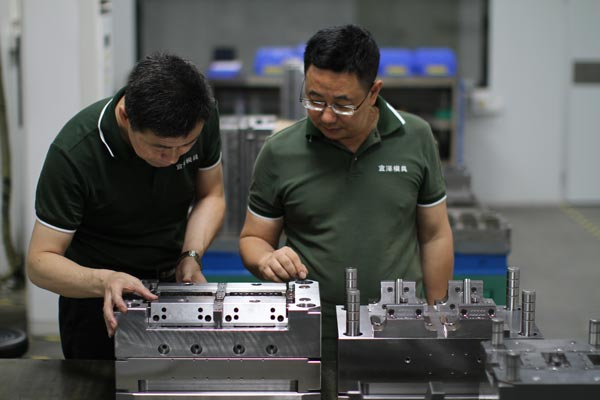
The manufacturing process directly determines the internal quality of the die. Machining precision must be strictly controlled within tolerance ranges to ensure assembly consistency and operational performance.
The choice of machining method is particularly critical. Cutting forces and cutting heat should be minimized to avoid micro-damage and residual deformation to the material. Cutting parameters must be carefully balanced to achieve both efficiency and quality. In addition, surface treatments such as sandblasting and polishing effectively remove burrs and oxide layers, improving surface quality and indirectly reducing the probability of crack initiation.
4. Heat Treatment: The Core Step for Eliminating Internal Stress
Heat treatment is the key process for improving the comprehensive performance of tungsten carbide dies. A scientifically designed heat treatment process can effectively eliminate internal residual stress and significantly enhance toughness and strength.
Heating temperature must be strictly controlled to avoid overheating or burning, with the appropriate temperature range selected based on material composition and performance requirements. The choice of cooling method also significantly affects the final microstructure. Tungsten carbide dies are typically cooled using oil or air, with the cooling medium and rate precisely controlled. Tempering treatment is indispensable. It eliminates brittle phases, stabilizes performance, and requires exact control of both temperature and duration.
5. Operation and Maintenance: The Last Line of Defense for Extending Service Life
Even when all preceding stages are executed flawlessly, improper use can still render the die useless.
During operation, standard operating procedures must be strictly followed. Overloading, overspeeding, and other improper practices must be eliminated. Machining parameters and cutting conditions should be matched to actual service conditions. Regular inspection must not become a mere formality. Surface condition, dimensional accuracy, and performance changes should be the focus of attention, with any anomalies addressed immediately. Lubrication maintenance is a daily operational priority. Proper lubrication effectively reduces friction and wear, lowering the probability of crack formation at the operational level.
6. Conclusion
Crack prevention for tungsten carbide dies is a full-chain engineering effort. From material source control at the front end, to stress resolution at the design stage, to precision assurance in manufacturing, to internal stress elimination through heat treatment, and finally to standardized operation and regular maintenance at the usage stage, no single link can be neglected. Only through systematic, end-to-end control can crack risk be minimized to the greatest extent, fully unlocking the performance potential of tungsten carbide dies.




 English
  Deutsch
  Français
  日本語
日本語  한국어
한국어  Español
  Português
  Italiano
  Nederlands
  Русский
  Bahasa Indonesia
  العربية