

Avoiding Damage Risks in Tungsten Carbide Die Operation – Yize Mould
Tungsten carbide dies are critical components in high-precision manufacturing, delivering unmatched hardness, wear resistance, and dimensional stability for applications in automotive, medical, electronics, and high-volume plastic injection industries. At Yize […]
Tungsten carbide dies are critical components in high-precision manufacturing, delivering unmatched hardness, wear resistance, and dimensional stability for applications in automotive, medical, electronics, and high-volume plastic injection industries. At Yize Mould, a precision mold manufacturer based in Dongguan, China — a global hub for advanced tooling — we ensure every die is engineered for longevity. To maximize service life and prevent catastrophic failure, follow these industry-aligned best practices.
1. Material Selection: Foundation of Performance
Select tungsten carbide grades with optimized tungsten-cobalt ratios (e.g., YG6, YG8, YG15) for balanced hardness and toughness. Prioritize materials with low impurity content and uniform grain distribution to minimize micro-crack initiation under cyclic stress. For high-wear applications, consider coated grades such as TiN or DLC-enhanced carbide to further reduce friction and adhesion wear.
Наш завод занимается: твердосплавные детали, детали пресс-форм, медицинские пресс-формы для литья под давлением, прецизионные пресс-формы для литья под давлением, литье тефлона PFA, фитинги для труб PFA. e-mail: [email protected],whatsapp:+8613302615729.
2. Design Optimization: Engineering for Durability
Design dies with reinforced stress zones and symmetrical load paths to prevent deformation under high-pressure forming. Integrate internal cooling channels to maintain consistent operating temperatures, avoiding thermal fatigue. Ensure precise alignment features and smooth surface transitions to eliminate stress concentrations. For medical and electronics applications, maintain surface roughness below Ra 0.05 to ensure part repeatability and sterilization compatibility.
3. Manufacturing Precision: From Powder to Product
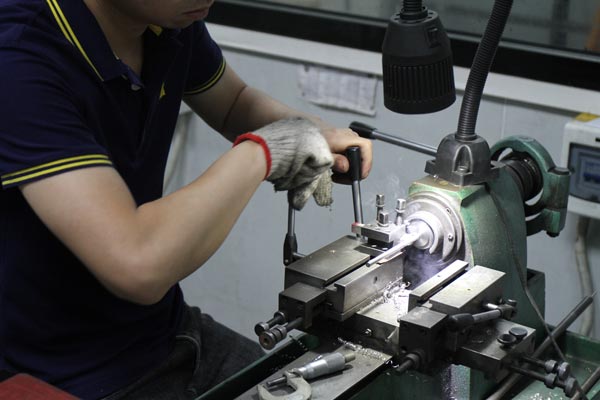
Leverage vacuum liquid-phase sintering at 1400–1500°C to achieve full density (>99%) and eliminate porosity. Employ CNC grinding and EDM with ±0.001mm tolerance control for critical cavities. Apply fine polishing to reduce surface defects that initiate wear. Every die must undergo 100% dimensional inspection using Nikon metrology systems to validate conformity to ISO 2768 standards.
4. Operational Maintenance: Extending Service Life
- Lubrication: Apply high-viscosity ISO VG 50 oil to guiding surfaces every 2 hours during initial runs; transition to daily application once stable.
- Inspection: Conduct weekly visual and magnified inspections for micro-cracks, chipping, or surface oxidation.
- Cleaning: Remove metal fines and polymer residues after each shift using non-abrasive solvents and lint-free wipes.
- Storage: Keep dies in climate-controlled, dry environments with anti-rust coatings; store in padded cases to prevent impact damage.
- Calibration: Revalidate critical dimensions quarterly using certified gauges to ensure dimensional integrity.
5. Proactive Failure Prevention
Avoid thermal shock by preheating dies before high-temperature cycles. Never exceed manufacturer-specified tonnage or cycle rates. Replace worn bushings and ejector pins immediately — delayed maintenance is the leading cause of die failure.
Frequently Asked Questions (FAQ)
Q: What is the typical service life of a tungsten carbide die under high-volume production?
A: With proper maintenance, tungsten carbide dies can last 5–10 times longer than tool steel dies, often exceeding 500,000 cycles in automotive and electronics applications. Life expectancy depends on material grade, load, and lubrication consistency.
Q: How can I detect early signs of micro-cracking in a tungsten carbide die?
A: Use a 10x–20x magnification loupe to inspect critical edges and corners for fine, hairline fractures. Surface discoloration or localized roughness may indicate subsurface stress. Non-destructive testing such as dye penetrant inspection is recommended for high-risk components.
Q: Is surface coating necessary for tungsten carbide dies in plastic molding?
A: Yes, especially for high-shear or abrasive resins (e.g., PEEK, LCP). TiN or DLC coatings reduce sticking, lower friction, and prevent polymer degradation on the die surface, extending clean-out intervals and reducing downtime.
Q: Can I use automated lubrication systems for tungsten carbide dies?
A: Absolutely. Automated systems are preferred in continuous production environments, provided they deliver precise, timed oil pulses (e.g., every 2 hours) using ISO VG 50 oil. Manual verification of nozzle output and filter condition is required weekly.



 English
  Deutsch
  Français
  日本語
日本語  한국어
한국어  Español
  Português
  Italiano
  Nederlands
  Русский
  Bahasa Indonesia
  العربية