

Carbide Bushings Manufacturing: Materials, Processes, Tolerances, and Quality Standards
What Are Carbide Bushings? Carbide bushings are cylindrical wear components designed to reduce friction, support rotating or sliding shafts, and protect mating parts from abrasion, impact, and high-pressure contact. Most […]
What Are Carbide Bushings?
Carbide bushings are cylindrical wear components designed to reduce friction, support rotating or sliding shafts, and protect mating parts from abrasion, impact, and high-pressure contact. Most carbide bushings are manufactured from cemented tungsten carbide, a composite material produced by pressing and sintering tungsten carbide grains with a metallic binder, typically cobalt or nickel. The resulting material combines exceptional hardness, high compressive strength, excellent wear resistance, and long service life under demanding operating conditions.
These bushings are widely used in industries where standard steel or bronze sleeves degrade quickly. Common applications include pump and valve assemblies, drilling and mining equipment, oil and gas downhole tools, extrusion dies, textile machinery, food and pharmaceutical processing equipment, and precision machinery that operates at high speeds or under heavy loads.
Наш завод занимается: твердосплавные детали, детали пресс-форм, медицинские пресс-формы для литья под давлением, прецизионные пресс-формы для литья под давлением, литье тефлона PFA, фитинги для труб PFA. e-mail: [email protected],whatsapp:+8613302615729.
Key Materials Used in Carbide Bushing Manufacturing
The performance of a carbide bushing begins with material selection. Manufacturers adjust carbide grade according to the operating environment, balancing hardness, toughness, corrosion resistance, and thermal stability.
Tungsten carbide grades are generally categorized by grain size, binder content, and binder type. Coarser grains and higher cobalt content deliver improved toughness and shock resistance, making them suitable for mining, drilling, and impact-heavy applications. Finer grains and lower binder content produce higher hardness and better abrasive wear performance, which are preferred for precision tools, sealing surfaces, and fine-finish sliding components.
For environments exposed to corrosive fluids, acidic media, or washdown processes, nickel-bonded or corrosion-resistant carbide grades may be selected. Manufacturers also consider hardness, density, transverse rupture strength, and porosity when recommending a grade, ensuring the bushing resists both wear and mechanical fracture during service.
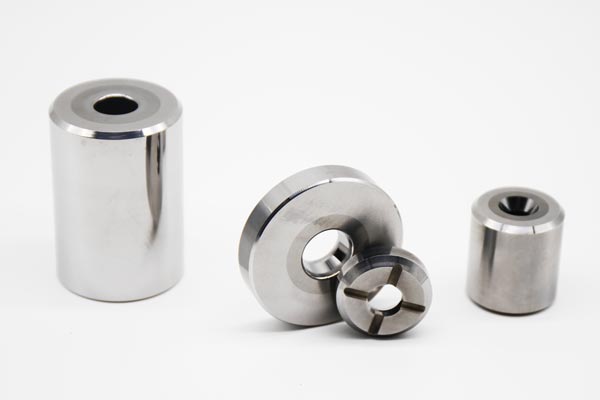
The Carbide Bushing Manufacturing Process
Carbide bushing production follows a controlled powder metallurgy workflow, where each stage influences dimensional accuracy, material density, and final wear performance.
Powder Preparation and Blending
The process starts with high-purity tungsten carbide powder, combined with the selected binder metal and processing additives. Powders are milled and blended to achieve uniform particle distribution, consistent grain size, and predictable sintering behavior. Precise powder preparation prevents density variation, carbide segregation, and internal defects that could reduce bushing strength.
Compaction and Green Forming
The blended powder is pressed into a preliminary cylindrical shape, commonly called a green compact. Depending on the required geometry and production volume, manufacturers may use die pressing, cold isostatic pressing, or a combination of both. Green parts are fragile and must be handled carefully to avoid cracking, edge damage, or uneven density before sintering.
Sintering
Sintering heats the compacted powder in a controlled furnace under vacuum or protective atmosphere, allowing the binder to melt, bond the carbide grains, and densify the material. Proper sintering temperature, hold time, and atmosphere control determine final hardness, density, porosity, and structural integrity. After sintering, the carbide reaches its full mechanical strength and wear resistance.
Precision Grinding and Machining
As-sintered carbide is extremely hard, so final dimensions are achieved through precision grinding and diamond machining. Manufacturers use cylindrical grinders, internal grinders, surface grinders, and diamond tools to reach required inner diameter, outer diameter, wall thickness, length, concentricity, and surface finish. This stage is critical for ensuring the bushing fits correctly, runs smoothly, and maintains a stable clearance with the mating shaft.
Finishing, Inspection, and Surface Treatment
Finished bushings may undergo honing, polishing, edge breaking, and cleaning to remove burrs and improve contact surfaces. Inspection covers dimensional measurement, hardness testing, density verification, visual defect checks, and non-destructive evaluation where required. Some applications also benefit from coated or polished surfaces that reduce friction, resist galling, and extend operating life.
Critical Design and Manufacturing Considerations
Effective carbide bushing manufacturing requires close alignment between part design, operating conditions, and material selection.
Dimensional tolerances directly affect assembly fit, running clearance, and heat distribution. Tight tolerances are typically required for high-speed rotation, precision sealing, and shaft support applications, while looser tolerances may be acceptable for heavy-duty wear sleeves. Wall thickness must also be balanced between rigidity and toughness, since overly thin walls can crack under impact, while excessively thick walls may increase cost and weight.
Surface finish influences friction, wear rate, and sealing performance. Smooth inner bores reduce shaft abrasion and heat buildup, while controlled edge geometry prevents stress concentration and cracking during installation. Manufacturers also consider lubrication conditions, operating temperature, shaft material, vibration levels, and the type of wear the bushing will encounter, whether abrasive, adhesive, erosive, or corrosive.
Quality Control and Testing in Production
Reliable carbide bushings depend on consistent quality control throughout production. Typical checks include raw material composition review, sintered density measurement, hardness testing, dimensional inspection with calibrated instruments, concentricity and runout verification, visual inspection for cracks or porosity, and sample validation against customer drawings or industry standards.
For critical applications such as downhole tools, medical equipment, or high-pressure pump components, manufacturers may provide material certifications, inspection reports, and traceability records. Clear documentation helps customers verify grade selection, dimensional compliance, and batch consistency, especially when parts are used in safety-sensitive or high-cost equipment.
Common Applications and Industry Requirements
Carbide bushings deliver the greatest value where wear resistance, dimensional stability, and long service life are priorities. In oil and gas and mining operations, they protect shafts and housings from abrasive slurries, impact, and repeated sliding contact. In pump and valve systems, they support rotating shafts, maintain alignment, and resist erosion from process fluids. In precision machinery and tooling, they provide durable guide surfaces that preserve accuracy over long production runs.
Different industries impose distinct requirements. Downhole components may resist high pressure, temperature cycling, and corrosive media; food and pharmaceutical equipment may require material compatibility and cleanable surfaces; high-speed machinery demands tight concentricity and balanced surface finish. Experienced manufacturers evaluate these conditions before recommending a carbide grade, tolerance level, and finishing method.
Choosing a Reliable Carbide Bushing Manufacturer
When sourcing carbide bushings, buyers should evaluate material expertise, production capability, precision equipment, inspection processes, and technical support. A capable manufacturer can assist with grade selection, drawing review, tolerance optimization, and problem solving for recurring wear or failure issues.
It is also important to communicate operating conditions clearly, including shaft speed, load, lubrication, temperature, abrasive or corrosive media, and expected service life. This information allows the manufacturer to produce a bushing that balances performance, durability, and cost efficiency rather than applying a generic carbide grade to every application.
Заключение
Carbide bushings manufacturing combines powder metallurgy, precision grinding, materials engineering, and rigorous quality control to produce wear-resistant components that protect critical machinery and reduce downtime. By selecting the right carbide grade, controlling the compaction and sintering process, and holding tight dimensional tolerances, manufacturers can deliver bushings that perform reliably under abrasive, high-load, and corrosive operating environments. Partnering with an experienced manufacturer helps ensure the final bushing matches the application’s requirements, extends equipment service life, and lowers long-term maintenance costs.
Frequently Asked Questions
What is a carbide bushing used for?
A carbide bushing is used to support shafts, guide sliding parts, reduce friction, and protect housings or mating components from wear, abrasion, impact, and corrosion. It is commonly installed in pumps, valves, drilling tools, mining equipment, extrusion machinery, and precision industrial systems.
How long do carbide bushings last compared with steel or bronze bushings?
Carbide bushings generally last significantly longer than steel or bronze alternatives in abrasive, high-load, or high-temperature applications. Their exact service life depends on the carbide grade, operating load, speed, lubrication, fluid chemistry, and the type of wear present in the application.
Can carbide bushings be custom manufactured to specific drawings?
Yes. Most carbide bushing suppliers produce custom parts based on customer drawings, including specific inner and outer diameters, length, wall thickness, tolerances, surface finish, and carbide grade. Providing detailed dimensions and operating conditions helps ensure the bushing fits and performs as required.
What factors affect carbide bushing wear resistance?
Wear resistance is influenced by carbide grain size, binder content, material grade, hardness, surface finish, dimensional fit, lubrication, operating temperature, load, speed, and the presence of abrasive particles or corrosive fluids. Matching the grade to the application is essential for maximizing service life.
Are carbide bushings suitable for high-temperature applications?
Carbide bushings can perform well at elevated temperatures, but the suitable grade and binder type must be selected carefully. High-temperature operation, thermal cycling, and corrosive environments may affect binder stability and toughness, so these conditions should be reviewed with the manufacturer before production.


 English
 Deutsch
 Français
 日本語
 한국어
 Español
 Português
 Italiano
 Nederlands
 Русский
 Bahasa Indonesia
 العربية