

How Tungsten Carbide Dies Cope with Extreme Working Environments
I. Introduction In industrial production, dies are indispensable tools. In extreme working environments such as high temperature, high pressure, and strong corrosion, the performance and stability of dies directly affect […]
I. Einleitung
In industrial production, dies are indispensable tools. In extreme working environments such as high temperature, high pressure, and strong corrosion, the performance and stability of dies directly affect production efficiency and product quality. Tungsten carbide dies, with their high hardness, high strength, high wear resistance, and excellent thermal stability, have become an ideal choice for dealing with such extreme environments. This article will delve into how tungsten carbide dies cope with extreme working environments and analyze their advantages and challenges in practical applications.
II. Strategies for Tungsten Carbide Dies to Cope with Extreme Working Environments
Material Selection and Optimization
The material selection of Wolframkarbid-Formen is the foundation for coping with extreme working environments. Tungsten carbide, as a high-performance alloy material, features a high melting point, high hardness, high strength, and good corrosion resistance. When selecting tungsten carbide materials, it is necessary to consider the specific requirements of the working environment, such as temperature range, pressure magnitude, and the type of corrosive media. Moreover, by optimizing the material composition and preparation process, the performance of tungsten carbide dies can be further enhanced.
Unser Fabrikgeschäft: Hartmetallteile, Formteile, medizinische Spritzgussformen, Präzisionsspritzgussformen, Teflon-PFA-Spritzguss, PFA-Rohrverschraubungen. E-Mail: [email protected],whatsapp:+8613302615729.
For example, in extremely high-temperature environments, choosing tungsten carbide materials with a higher tungsten content can improve their high-temperature resistance. Adding appropriate amounts of rare earth elements and trace elements can enhance the toughness and fatigue resistance of tungsten carbide, thereby extending the service life of the die.
Design and Structural Innovation
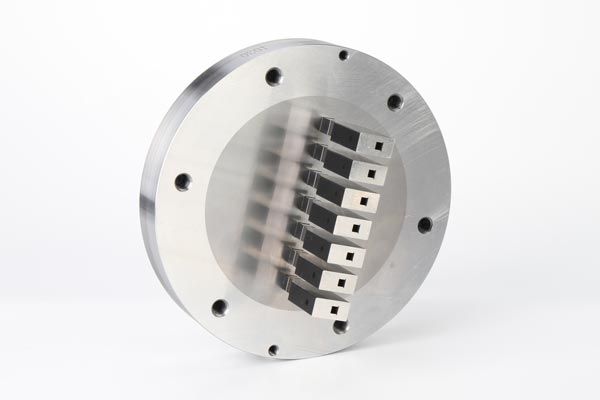
In extreme working environments, design and structural innovation of dies are crucial for improving their performance and stability. Firstly, the structure and dimensions of the die should be reasonably designed according to the requirements of the working environment. For instance, in high-temperature environments, a hollow structure or the addition of heat dissipation devices can be adopted to reduce the working temperature of the die. Secondly, a modular design can be employed, dividing the die into several independent modules for easy maintenance and replacement. In addition, advanced simulation technologies and optimization design methods can be used to precisely design and optimize the die, improving its performance and stability.
Manufacturing Process and Quality Control
The manufacturing process and quality control are the core aspects to ensure the stable performance of tungsten carbide dies. During the manufacturing process, strict control of the process parameters and quality standards at each stage is essential. For example, in the heat treatment process, appropriate heating and cooling rates should be selected to achieve the optimal hardness and toughness of the die. In the machining process, high-precision machining equipment and process methods should be adopted to ensure the dimensional accuracy and surface quality of the die. At the same time, strict inspection and testing of the die should be carried out to ensure that it meets the design requirements and quality standards.
Coating and Surface Treatment
Coating and surface treatment are effective means to improve the performance of tungsten carbide dies. In extreme working environments, coating and surface treatment can further enhance the wear resistance, corrosion resistance, and high-temperature resistance of the die. For example, vacuum coating technology can be used to coat a layer of high-hardness and high-wear-resistant coating on the surface of the die to improve its wear resistance. Ion implantation and chemical vapor deposition and other surface treatment technologies can also be employed to improve the chemical stability and corrosion resistance of the die surface.
Maintenance and Upkeep
In extreme working environments, the maintenance and upkeep of tungsten carbide dies are particularly important. Firstly, the die should be regularly inspected and repaired to promptly detect and address potential problems. Secondly, the die should be regularly cleaned and maintained to remove dirt and impurities on the surface and keep it in good working condition. In addition, according to changes in the working environment, the operating methods and parameters of the die should be adjusted on time to ensure its stable and reliable performance.
III. Application Examples of Tungsten Carbide Dies in Extreme Working Environments
Tungsten carbide dies have a wide range of applications in extreme working environments such as high temperature, high pressure, and strong corrosion. In the aerospace field, tungsten carbide dies are widely used for manufacturing high-precision parts such as engine components and airfoil parts. In high-temperature environments, tungsten carbide dies can maintain stable performance, ensuring the precision and quality of the parts. In the chemical industry, tungsten carbide dies are used for manufacturing corrosion-resistant equipment and pipelines, and their excellent corrosion resistance can effectively resist the erosion of corrosive media.
IV. Challenges and Solutions Faced by Tungsten Carbide Dies in Extreme Working Environments
Although tungsten carbide dies have excellent performance in extreme working environments, they still face some challenges. For example, in high-temperature environments, the high thermal expansion coefficient of tungsten carbide dies may lead to dimensional changes and reduced precision. To solve this problem, advanced heat treatment technologies and structural design methods can be adopted to reduce the thermal expansion coefficient of the die. In strong corrosion environments, the corrosion resistance of tungsten carbide dies may be challenged. To address this issue, coating and surface treatment technologies can be used to improve the corrosion resistance of the die.
V. Schlussfolgerung
Tungsten carbide dies, with their high hardness, high strength, high wear resistance, and excellent thermal stability, have become an ideal choice for coping with extreme working environments. Through efforts in material selection and optimization, design and structural innovation, manufacturing process and quality control, coating and surface treatment, as well as maintenance and upkeep, the performance and stability of tungsten carbide dies in extreme working environments can be further improved. At the same time, corresponding solutions can be taken to deal with the possible challenges faced by tungsten carbide dies in extreme working environments, enabling them to better adapt to such environments and provide strong support for industrial production.




 English
  Deutsch
  Français
  日本語
日本語  한국어
한국어  Español
  Português
  Italiano
  Nederlands
  Русский
  Bahasa Indonesia
  العربية