
Manufacturing Process of Tungsten Carbide Dies
Tungsten carbide dies are indispensable tools in modern precision manufacturing, renowned for their exceptional hardness, wear resistance, and thermal stability. Their production demands a highly controlled, multi-stage process to ensure […]
Tungsten carbide dies are indispensable tools in modern precision manufacturing, renowned for their exceptional hardness, wear resistance, and thermal stability. Their production demands a highly controlled, multi-stage process to ensure dimensional accuracy, surface integrity, and operational longevity. This document outlines the essential manufacturing steps—from material selection to final inspection—designed to meet the rigorous demands of high-performance industrial applications.
Material Selection and Preparation
Unser Fabrikgeschäft: Hartmetallteile, Formteile, medizinische Spritzgussformen, Präzisionsspritzgussformen, Teflon-PFA-Spritzguss, PFA-Rohrverschraubungen. E-Mail: [email protected],whatsapp:+8613302615729.
The foundation of a high-quality tungsten carbide die lies in the selection of appropriate powder metallurgy compositions, typically based on tungsten carbide (WC) bonded with cobalt (Co) in varying ratios (e.g., 6–12% Co). Material grade selection must align with application-specific requirements such as impact resistance, abrasion tolerance, and operating temperature. Raw powder is meticulously blended, dried, and compacted into green blanks that conform to the die’s nominal geometry. Surface cleaning and degreasing are performed to eliminate contaminants prior to sintering.
Green Machining
Prior to sintering, the compacted green blank undergoes rough machining using CNC milling or turning to approximate the final shape. This stage removes excess material while preserving dimensional allowances for subsequent processing. Tool wear is closely monitored due to the abrasive nature of green compacts, and coolant systems are employed to prevent thermal distortion.
Sintering
Sintering is the critical phase where the green compact is heated in a controlled atmosphere furnace to temperatures near the melting point of cobalt (typically 1350–1500°C). This process densifies the material, eliminating porosity and achieving near-theoretical density. Temperature profiles, soak times, and cooling rates are precisely calibrated to control grain growth and residual stress, directly influencing hardness and fracture toughness.
Post-Sintering Machining
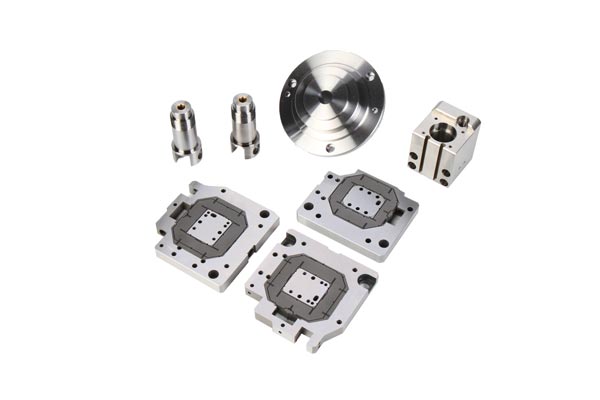
Due to the extreme hardness of sintered tungsten carbide (>90 HRA), conventional cutting tools are ineffective. Finishing is performed using diamond grinding, electrical discharge machining (EDM), or laser ablation. These methods enable micron-level tolerances and complex geometries. Process parameters—including feed rate, spindle speed, and electrode configuration—are optimized to minimize subsurface damage and achieve required surface integrity.
Polishing and Surface Finishing
Surface polishing is conducted using diamond paste or lapping compounds on precision polishing machines. The goal is to achieve surface roughness values of Ra ≤ 0.05 μm, critical for reducing friction, preventing material adhesion, and ensuring consistent part ejection. Polishing is performed in stages, progressing from coarse to ultra-fine abrasives, with periodic inspection under optical microscopy.
Inspection and Packaging
Final inspection includes dimensional verification via coordinate measuring machines (CMM), hardness testing (HRA or HRC), and surface defect analysis using profilometry or automated optical inspection. Dies failing to meet tolerances are either reworked or scrapped. Qualified dies are individually wrapped in anti-corrosion paper, sealed in vacuum bags with desiccant, and packed in shock-absorbing crates to prevent damage during transit and storage.
FAQ
Q1: Can tungsten carbide dies be machined using standard high-speed steel tools?
No. Tungsten carbide’s hardness exceeds 90 HRA, rendering standard HSS tools ineffective. Only diamond abrasives, EDM, or laser systems can achieve precision machining after sintering.
Q2: Why is sintering atmosphere critical in die manufacturing?
The sintering atmosphere—typically vacuum or hydrogen—prevents oxidation of cobalt binder and tungsten carbide particles. Contaminated atmospheres lead to porosity, embrittlement, and reduced wear resistance.
Q3: How does cobalt content affect die performance?
Higher cobalt content (e.g., 10–12%) increases toughness and impact resistance, suitable for stamping or forming applications. Lower cobalt (e.g., 6–8%) enhances hardness and wear resistance, ideal for wire drawing or extrusion dies.
Q4: Is surface polishing optional for tungsten carbide dies?
No. Even micro-scale surface irregularities can cause material sticking, inconsistent part dimensions, or premature wear. Polishing to Ra ≤ 0.05 μm is mandatory for high-precision applications.
Q5: What is the typical lifespan of a tungsten carbide die?
Lifespan varies by application but commonly exceeds 500,000 cycles in wire drawing and 100,000+ cycles in cold forging. Proper maintenance, lubrication, and avoidance of overload conditions significantly extend service life.
Verwandte Beiträge
- Selecting Optimal Wear-Resistant Coatings for Tungsten Carbide Dies
- Professional Business-Style English Revision: Fundamental Principles and Applications of Tungsten Carbide Dies
- Performance Stability Management Strategy for Tungsten Carbide Dies Under High-Load Conditions
- Applications of Tungsten Carbide Dies in the Electronics Industry


 English
  Deutsch
  Français
  日本語
日本語  한국어
한국어  Español
  Português
  Italiano
  Nederlands
  Русский
  Bahasa Indonesia
  العربية