

Title: Detailed Process of Tungsten Carbide Die Polishing Treatment
In the field of die manufacturing, tungsten carbide dies are widely used in precision machining applications due to their exceptional properties, including high hardness, high strength, and superior thermal stability. […]
In the field of die manufacturing, tungsten carbide dies are widely used in precision machining applications due to their exceptional properties, including high hardness, high strength, and superior thermal stability. However, dies inevitably suffer from wear and oxidation during prolonged use. Therefore, periodic polishing is a critical step in maintaining die performance and service life by restoring surface finish and dimensional accuracy. The following provides a systematic elaboration of the complete tungsten carbide die polishing process.
- Preliminary Preparation
Before commencing polishing operations, thorough preparation is essential. First, conduct a comprehensive inspection of the die surface condition, confirm basic information such as die material, structural configuration, and dimensional specifications, and establish the polishing objectives and technical requirements accordingly. At the same time, prepare all necessary equipment and consumables, including polishing machines, sandpaper, polishing compound, and dedicated cleaning agents.
Unser Fabrikgeschäft: Hartmetallteile, Formteile, medizinische Spritzgussformen, Präzisionsspritzgussformen, Teflon-PFA-Spritzguss, PFA-Rohrverschraubungen. E-Mail: [email protected],whatsapp:+8613302615729.
- Surface Pretreatment
Surface pretreatment is the first critical step in the polishing workflow. Its primary objective is to remove oil stains, rust, oxide layers, and other contaminants from the die surface, as well as to repair minor scratches and depressions. The specific operations are as follows:
Cleaning: Use a cleaning agent specifically compatible with tungsten carbide material to thoroughly clean the die surface, removing oil residues and dust. Care must be taken to select cleaning agents that will not cause corrosion or damage to the tungsten carbide substrate.
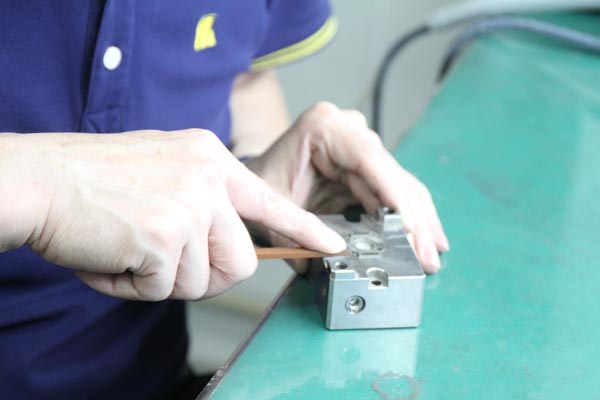
Rust and Oxide Removal: For areas with rust or oxide layers, specialized chemical rust removers or sandpaper may be used. The chemical agent must be confirmed as non-damaging to tungsten carbide material, and the sandpaper grit should be selected based on the surface roughness level.
Defect Repair: Minor scratches and localized depressions on the die surface can be addressed using a leveling machine or sandpaper. During repair, strict attention must be paid to maintaining the flatness and finish of the die surface.
- Rough Polishing
Rough polishing is a core stage that determines the final surface quality. In this phase, sandpaper is used to progressively grind the die surface, eliminating uneven and rough areas. Key operational points are as follows:
Sandpaper Selection: Choose sandpaper with appropriate grit based on the die surface roughness and the required polishing grade. The general principle is to progress from coarse to fine, starting with coarser grit for initial grinding and gradually transitioning to finer grit.
Force and Angle Control: During grinding, strictly control the applied force and angle to prevent excessive wear or secondary scratching of the die surface. Uniformity and consistency in grinding must also be maintained to ensure surface flatness and finish.
Progress Monitoring: Regularly inspect the surface condition during rough polishing. If unresolved rough areas or signs of excessive wear are detected, adjust the grinding method and force promptly.
- Fine Polishing
After rough polishing is completed, fine polishing is required to elevate surface finish and dimensional precision further. This stage typically employs a polishing machine in conjunction with polishing compound. Key operational points are as follows:
Polishing Compound Selection: Select a polishing compound that matches the tungsten carbide die material and the required polishing grade. The choice of compound directly determines the final surface quality.
Time and Speed Control: Precisely control polishing duration and rotational speed during fine polishing to prevent surface burning or dimensional deviation caused by excessive friction. Ensure the polishing machine operates stably to guarantee consistency and reliability of the polishing results.
In-Process Inspection: Continuously monitor the surface condition during fine polishing. If residual defects or scratches are found, perform targeted corrective treatment immediately.
- Cleaning and Drying
Upon completion of polishing, the die must undergo thorough cleaning and drying. The purpose of cleaning is to remove residual polishing compound particles and contaminants, ensuring surface cleanliness and finish. Clean the die using a dedicated cleaning agent or clean water, then dry with a lint-free cloth or compressed air.
- Qualitätskontrolle
The final step is comprehensive quality inspection of the polished tungsten carbide die. Inspection covers key indicators including surface finish, flatness, and dimensional accuracy. If any defects or non-conformities are identified, corrective action must be taken promptly until all specifications are met.
- Key Precautions
Safety Compliance: Polishing operations must strictly follow safety protocols. Operators are required to wear protective eyewear, gloves, and other personal protective equipment to prevent accidents.
Environmental Compliance: Waste water, waste residue, and other pollutants generated during polishing must be properly disposed of in accordance with environmental regulations to avoid environmental contamination.
Equipment Maintenance: Polishing equipment must be subject to regular maintenance and servicing to ensure stable operation and extend service life.
In summary, tungsten carbide die polishing is a complex and precision-demanding systematic process that requires solid technical expertise and practical experience. By strictly adhering to standardized procedures and observing all relevant precautions, the surface finish and dimensional accuracy of the die can be reliably maintained, significantly extending die service life and improving machining efficiency.





 English
  Deutsch
  Français
  日本語
日本語  한국어
한국어  Español
  Português
  Italiano
  Nederlands
  Русский
  Bahasa Indonesia
  العربية