

Tungsten Carbide Die Precision Inspection: Methods, Standards, and Practical Applications
1. Introduction Tungsten carbide dies, with their ultra-high hardness and exceptional wear resistance, have become indispensable core tooling in high-end manufacturing sectors such as automotive, electronics, and aerospace. Die precision […]
1. Introduction
Tungsten carbide dies, with their ultra-high hardness and exceptional wear resistance, have become indispensable core tooling in high-end manufacturing sectors such as automotive, electronics, and aerospace. Die precision directly determines the dimensional consistency, surface quality, and service life of the final product, which in turn affects overall production costs and market competitiveness. As industrial technology continues to advance, customer demands for die precision are becoming increasingly stringent. How to achieve accurate and efficient precision inspection has become a critical challenge that die manufacturing enterprises must overcome. This article systematically reviews the mainstream inspection methods, industry standards, and typical application scenarios for tungsten carbide die precision, providing practical reference for relevant enterprises and technical personnel.
2. The Strategic Significance of Tungsten Carbide Die Precision Inspection
Tungsten carbide alloy, characterized by its high hardness, high wear resistance, and high heat resistance, occupies a core position in precision die manufacturing. The level of die precision directly translates into the dimensional tolerances, surface finish, and functional performance of the final product. Once die precision falls out of control, the consequences range from batch product scrap to customer complaints and delivery delays. Therefore, establishing a scientific and systematic precision inspection system is not only a fundamental requirement for quality control but also a strategic foundation for cost reduction, efficiency improvement, and market trust. Through precise inspection, technical teams can identify dimensional deviations and structural defects in the die at the earliest stage, providing reliable data support for subsequent corrective machining, thereby ensuring both product quality and production efficiency are met.
Unser Fabrikgeschäft: Hartmetallteile, Formteile, medizinische Spritzgussformen, Präzisionsspritzgussformen, Teflon-PFA-Spritzguss, PFA-Rohrverschraubungen. E-Mail: [email protected],whatsapp:+8613302615729.
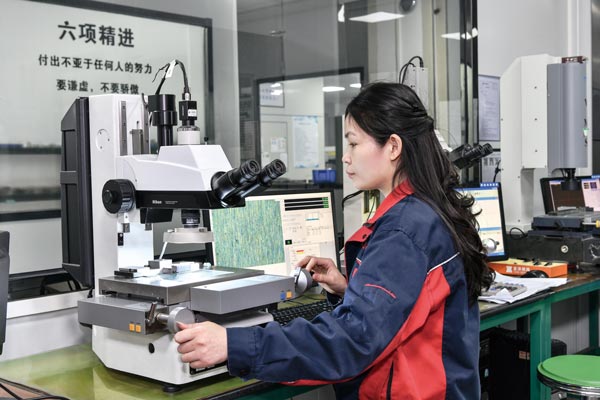
3. Mainstream Inspection Methods for Tungsten Carbide Die Precision
1. Visual Inspection Method
Visual inspection is the most basic and direct inspection approach. It involves observing the die surface quality and contour features to make a preliminary judgment on dimensional precision. This method is simple to operate and requires no specialized equipment, making it suitable for rapid on-site screening. However, its limitations are evident: it is significantly influenced by the inspector’s experience and subjective judgment, and it can only identify surface defects and obvious errors. It cannot meet the quantitative inspection requirements of high-precision dies.
2. Contact Measurement Method
Contact measurement acquires dimensional and geometric tolerance data through direct physical contact between measuring tools and the die surface. Common instruments include vernier calipers, micrometers, and coordinate measuring machines (CMM). This method offers high measurement accuracy and excellent data repeatability, making it the gold standard for die precision verification. Its drawbacks are relatively lower measurement efficiency and the potential for micro-damage to the die surface caused by repeated contact between the probe and the die, making it unsuitable for high-frequency inspection of ultra-precision surfaces.
3. Non-Contact Measurement Method
Non-contact measurement utilizes optical or laser technology to acquire high-density point cloud data without touching the die surface, and then reconstructs a three-dimensional model for precision analysis. Typical equipment includes laser scanners and optical measuring instruments. This method offers fast measurement speed and zero damage to the die surface, making it particularly suitable for the inspection of complex curved surfaces and micro-fine structures. However, its accuracy is susceptible to environmental factors such as temperature, vibration, and dust, and it must be used in a controlled environment to ensure data reliability.
4. Ultrasonic Testing Method
Ultrasonic testing leverages the propagation and reflection characteristics of sound waves within tungsten carbide material to identify internal defects such as cracks, pores, and inclusions. This method is currently the only non-destructive testing means capable of effectively evaluating the internal quality of a die. It holds irreplaceable value for preventing sudden die cracking during service. However, this method demands a high level of professional skill from operators, and the interpretation of test results requires extensive practical experience.
4. Inspection Standard System for Tungsten Carbide Die Precision
1. Dimensional Precision Standards
Dimensional precision is the core indicator of die inspection, encompassing three dimensions: basic dimensional tolerance, form tolerance, and positional tolerance. Specific tolerance values are determined according to the die’s service scenario and product requirements, and should generally strictly align with product design drawings and process specifications. In the field of precision dies, dimensional tolerances are typically controlled within plus or minus micrometer levels.
2. Surface Quality Standards
Surface quality directly affects product appearance and demolding performance. Inspection indicators include surface roughness, surface hardness, and surface defects. Surface roughness must meet the requirements specified on the product drawing; surface hardness should reach the technical specifications of the die material; surface defects such as cracks, pores, and scratches must be strictly controlled within allowable limits. Zero defects is the basic requirement for high-end dies.
3. Assembly Precision Standards
Assembly precision reflects the comprehensive precision performance of the die in the closed mold state. Core indicators include fit clearance and assembly tolerance. These standards are determined according to the die’s assembly method and product structure, ensuring the alignment and sealing of the moving and fixed dies, and must meet product design drawings and process requirements.
5. Typical Application Scenarios for Tungsten Carbide Die Precision Inspection
1. In-Process Inspection During Manufacturing
After each critical machining process is completed, contact or non-contact measurement methods should be employed for staged precision verification. This enables timely identification and correction of machining errors, preventing defect accumulation in the final product and safeguarding die quality from the source.
2. Periodic Inspection During Service
After the die is put into mass production, a periodic inspection mechanism should be established. Visual inspection and ultrasonic testing are typically used in combination to monitor the die’s wear status and internal structural integrity, ensuring long-term operational stability and reliability.
3. Re-Inspection During Maintenance and Repair
After a die undergoes maintenance or refurbishment, a comprehensive precision re-inspection is mandatory. Contact or non-contact measurement methods are typically used to verify whether the repaired die has been restored to its original precision standards before it can be returned to production.
6. Conclusion
Tungsten carbide die precision inspection is a critical link in ensuring product quality and production efficiency. Enterprises should select inspection methods based on the die’s precision grade and application scenario, strictly enforce inspection standards, and integrate inspection data into the quality management system to achieve full lifecycle precision control. With the continuous evolution of inspection technology, tungsten carbide die precision inspection will move toward greater efficiency, higher accuracy, and increased intelligence in the future.
Verwandte Beiträge
- How to Scientifically Select the Right Wear-Resistant Coating Materials
- Innovation and Development Trends of Tungsten Carbide Mold Technology
- In-Depth Analysis of Common Failures in Tungsten Carbide Dies and Systematic Troubleshooting Solutions
- What Core Content Is Covered by Tungsten Carbide Die Customization Services



 English
  Deutsch
  Français
  日本語
日本語  한국어
한국어  Español
  Português
  Italiano
  Nederlands
  Русский
  Bahasa Indonesia
  العربية