
CNC Machining Tungsten Carbide: Precision Solutions for Industrial Excellence
Introduction In the landscape of advanced manufacturing, tungsten carbide stands as one of the most formidable engineering materials available today. When combined with the precision of computer numerical control (CNC) […]
Pendahuluan
In the landscape of advanced manufacturing, tungsten carbide stands as one of the most formidable engineering materials available today. When combined with the precision of computer numerical control (CNC) machining, it unlocks a new dimension of component performance — delivering exceptional hardness, wear resistance, and dimensional accuracy that conventional materials simply cannot match. For industries ranging from aerospace to oil and gas, CNC machined tungsten carbide components have become indispensable in applications where durability and precision are non-negotiable.
Understanding Tungsten Carbide as an Engineering Material
Tungsten carbide (WC) is a composite material formed by combining tungsten and carbon particles, typically bonded with cobalt through powder metallurgy. The result is a material with a hardness second only to diamond, a melting point exceeding 2,800°C, and remarkable compressive strength. Unlike traditional tool steels, tungsten carbide retains its hardness at elevated temperatures, making it ideal for high-speed cutting operations and extreme working environments.
Bisnis pabrik kami: suku cadang karbida, suku cadang cetakan, cetakan injeksi medis, cetakan injeksi presisi, cetakan injeksi PFA teflon, alat kelengkapan tabung PFA. email: [email protected],whatsapp:+8613302615729.
The material’s properties can be fine-tuned by adjusting the cobalt binder content and grain size. Higher cobalt ratios improve toughness but slightly reduce hardness, while finer grain structures enhance both hardness and wear resistance. This versatility allows manufacturers to engineer carbide grades tailored to specific application requirements — from impact-resistant mining tools to ultra-precise micro-drills for electronics manufacturing.
The CNC Machining Process for Tungsten Carbide
CNC machining of tungsten carbide requires specialized equipment, tooling, and process expertise due to the material’s extreme hardness and brittleness. The process typically follows a carefully controlled workflow to ensure accuracy while minimizing the risk of cracking or chipping.
Material Preparation and Roughing
The process begins with near-net-shape carbide blanks produced through powder metallurgy — pressing and sintering WC-Co powder into preformed shapes. CNC roughing operations remove excess material using diamond-coated end mills or polycrystalline diamond (PCD) cutting tools. Cutting parameters are carefully calibrated: lower feed rates, moderate spindle speeds, and rigid machine setups help manage the high cutting forces and prevent thermal damage to the workpiece.
Precision Finishing Operations
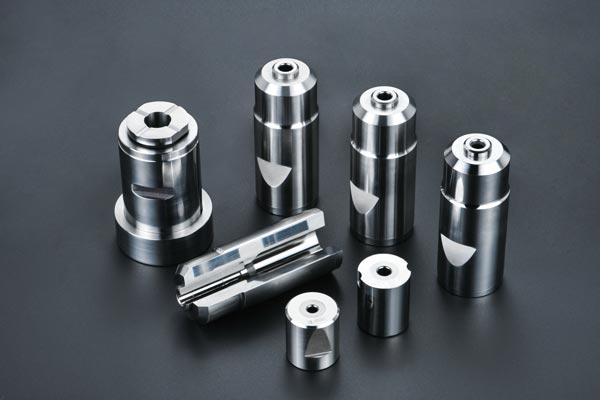
Following roughing, precision finishing achieves final dimensions with tolerances often measured in microns. Grinding is the most common finishing method for tungsten carbide, utilizing diamond grinding wheels with CNC-controlled multi-axis movement. Surface grinding, cylindrical grinding, and internal grinding are employed based on component geometry. Advanced CNC grinding centers can achieve surface finishes as smooth as Ra 0.2 μm while maintaining tight geometric tolerances.
EDM for Complex Geometries
For intricate features, internal cavities, or sharp corners that are difficult to achieve with conventional cutting, wire electrical discharge machining (wire EDM) or sinker EDM is utilized. EDM removes material through controlled electrical discharges, making it ideal for processing hard, brittle materials like tungsten carbide without introducing mechanical stress. CNC-controlled EDM systems can produce complex 2D and 3D profiles with exceptional precision, making them essential for manufacturing dies, punches, and custom tooling.
Secondary Operations
Post-machining processes may include lapping, polishing, and coating applications. Physical vapor deposition (PVD) coatings such as titanium nitride (TiN), titanium carbonitride (TiCN), or diamond-like carbon (DLC) can further enhance surface properties, reducing friction and extending component service life. Quality inspection, including coordinate measuring machine (CMM) verification and surface roughness testing, ensures every component meets specification.
Key Advantages of CNC Machined Tungsten Carbide Components
Exceptional Wear Resistance
Tungsten carbide components exhibit wear resistance up to 100 times greater than steel, dramatically extending service life in abrasive environments. This translates to reduced downtime, fewer replacements, and lower total cost of ownership for industrial equipment.
Superior Hardness at Elevated Temperatures
Unlike high-speed steel, which softens significantly at temperatures above 500°C, tungsten carbide maintains its hardness well beyond 800°C. This property makes it indispensable for high-speed cutting tools and components operating in high-temperature industrial processes.
Dimensional Stability and Precision
CNC machining enables the production of tungsten carbide components with micron-level accuracy and excellent repeatability. The material’s low thermal expansion coefficient ensures dimensional stability even under fluctuating operating temperatures, critical for precision tooling and measuring instruments.
Corrosion and Chemical Resistance
Tungsten carbide is highly resistant to most acids, alkalis, and corrosive chemicals, making it suitable for use in harsh chemical processing, offshore drilling, and marine applications where steel components would rapidly degrade.
Industrial Applications of CNC Machined Tungsten Carbide
Cutting Tools and Tooling Systems
The largest application segment for CNC machined tungsten carbide is metalworking cutting tools — including turning inserts, milling cutters, drills, reamers, and end mills. These tools enable higher cutting speeds, longer tool life, and superior surface finishes across a wide range of workpiece materials from aluminum to hardened steel and superalloys.
Oil and Gas Industry
In oil and gas exploration, tungsten carbide components are critical for downhole tools, drill bits, valve trims, and wear sleeves. Their ability to withstand extreme pressure, abrasive drilling fluids, and corrosive environments ensures reliable performance in the harshest well conditions.
Aerospace and Defense
Aerospace manufacturers rely on tungsten carbide tooling for machining titanium alloys, Inconel, and other difficult-to-cut materials used in jet engines and airframe structures. Precision carbide components are also used in guidance systems, landing gear, and armor-piercing applications.
Automotive Manufacturing
The automotive industry employs tungsten carbide dies, punches, and forming tools for sheet metal stamping, forging, and extrusion operations. CNC machined carbide tooling ensures consistent part quality and extends production runs between tool changes.
Electronics and Semiconductor
In electronics manufacturing, micro-precision carbide tools — including micro-drills with diameters as small as 0.01 mm — are essential for PCB fabrication and semiconductor packaging. The extreme precision of CNC machined carbide enables the miniaturization trends driving the electronics industry.
Quality Assurance and Material Selection Considerations
Selecting the right tungsten carbide grade is paramount to achieving optimal performance. Factors to consider include the operating environment (temperature, corrosion, abrasion), mechanical loads (impact vs. static loading), required precision, and cost constraints. Reputable CNC machining partners will work with clients to match carbide grades — from K10 for high-wear applications to K30 for tougher, impact-resistant requirements — with specific application needs.
Quality assurance is equally critical. Advanced inspection techniques, including optical comparators, CMM measurement, surface roughness analysis, and hardness testing, ensure that each machined component meets the highest standards. ISO-certified machining facilities with clean room capabilities are essential for industries with stringent quality requirements such as medical device and semiconductor manufacturing.
The Future of CNC Machined Tungsten Carbide
The tungsten carbide machining industry continues to evolve with advances in CNC technology, coating innovations, and material science. Five-axis CNC machining centers enable the production of increasingly complex geometries in a single setup, while developments in ultra-fine grain carbide grades push the boundaries of hardness and toughness. Additive manufacturing techniques, though still emerging for tungsten carbide, promise further design freedom and material efficiency in the years ahead.
As global manufacturing trends toward higher precision, greater efficiency, and longer component life, the demand for CNC machined tungsten carbide solutions will only grow. Manufacturers that invest in advanced machining capabilities and deep material expertise will be best positioned to serve the evolving needs of high-performance industries.
Frequently Asked Questions (FAQ)
Q: What is the difference between tungsten carbide and steel in CNC machining?
A: Tungsten carbide is significantly harder and more wear-resistant than steel, but it is also more brittle and requires specialized tooling such as PCD or diamond-coated cutters. Steel can be machined with standard carbide tools at higher feed rates, while tungsten carbide requires slower, more controlled cutting parameters. EDM and grinding are also more commonly used for carbide due to its extreme hardness.
Q: How accurate can CNC machined tungsten carbide components be?
A: With precision CNC grinding and EDM processes, tungsten carbide components can achieve tolerances as tight as ±0.001 mm (1 micron) for critical features. Surface finishes can reach Ra 0.1 μm with lapping and polishing operations. Actual achievable tolerances depend on component geometry, size, and the specific machining methods employed.
Q: What industries benefit most from tungsten carbide CNC machining?
A: Industries that require exceptional wear resistance, high-temperature performance, and precision benefit most. These include oil and gas, aerospace, automotive manufacturing, metalworking tooling, electronics and semiconductor, mining, and medical device manufacturing. Any application where component failure due to wear or heat would cause costly downtime is a strong candidate for tungsten carbide.
Q: Is CNC machining tungsten carbide more expensive than machining steel?
A: Yes, the initial cost of tungsten carbide material and machining is higher than steel due to the material’s hardness, longer machining times, and specialized tooling requirements. However, when evaluated on a total cost of ownership basis, tungsten carbide components often provide significant savings through extended service life, reduced downtime, and fewer replacements — making them highly cost-effective for demanding applications.
Q: Can complex 3D shapes be produced with CNC machined tungsten carbide?
A: Yes, complex 3D geometries can be produced using multi-axis CNC grinding centers and 5-axis machining capabilities, combined with EDM for internal features. While the material’s hardness limits certain conventional milling operations, advanced grinding and EDM technologies enable the production of intricate dies, molds, cutting tools, and custom components with sophisticated three-dimensional profiles.
Posting Terkait
- Precision Carbide Machining Process: Advanced Methods and Industrial Standards
- Carbide vs Ceramic Materials: A Comprehensive Guide to Wear Resistant Materials
- Carbide vs Steel: A Comprehensive Comparison for Industrial Component Selection
- Carbide Grades Selection Guide: Choosing the Right Tungsten Carbide for Your Application

 English
  Deutsch
  Français
  日本語
日本語  한국어
한국어  Español
  Português
  Italiano
  Nederlands
  Русский
  Bahasa Indonesia
  العربية