
Professional Business-Style English Revision: Fundamental Principles and Applications of Tungsten Carbide Dies
In modern manufacturing, dies are indispensable tools for shaping components with precise geometries. Among material options, tungsten carbide dies have become the preferred solution for high-precision, high-wear applications due to […]
In modern manufacturing, dies are indispensable tools for shaping components with precise geometries. Among material options, tungsten carbide dies have become the preferred solution for high-precision, high-wear applications due to their unmatched mechanical resilience. This document presents a refined technical overview of tungsten carbide die fundamentals—including material composition, manufacturing protocols, operational mechanics, and strategic advantages—to guide industrial procurement and engineering design.
Material Properties of Tungsten Carbide Dies
Tungsten carbide dies consist of tungsten carbide grains bonded with a metallic binder, typically cobalt, forming a composite with exceptional performance under extreme conditions:
La nostra attività in fabbrica: parti in metallo duro, parti di stampi, stampi a iniezione medicali, stampi a iniezione di precisione, stampaggio a iniezione di teflon PFA, raccordi per tubi PFA. e-mail: [email protected],whatsapp:+8613302615729.
Exceptional Hardness: Achieves HRA 89–94, significantly exceeding tool steel, enabling resistance to plastic deformation under high compressive loads.
Superior Wear Resistance: Maintains surface integrity through thousands of forming cycles, minimizing dimensional drift and surface degradation in abrasive environments.
Thermal Stability: Retains structural rigidity up to 1000°C, with negligible thermal expansion (4.5–5.5 × 10⁻⁶ /°C), ensuring consistent performance in hot-forming processes.
Chemical Inertness: Resists corrosion from acids, alkalis, and lubricants, making it suitable for use in chemically aggressive or high-humidity production settings.
Manufacturing Process
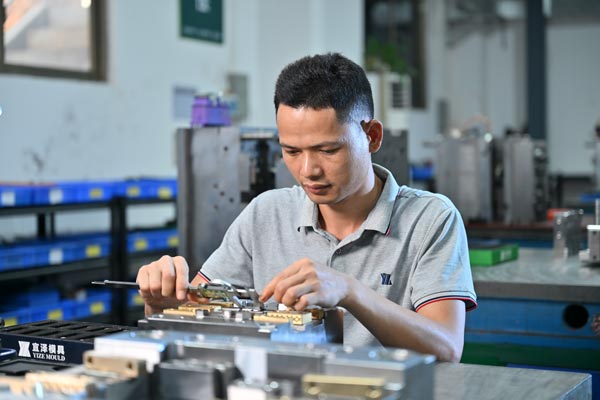
The fabrication of tungsten carbide dies follows a precision-engineered sequence:
Powder Selection: High-purity tungsten carbide powder (0.2–5 μm grain size) is blended with 6–15% cobalt binder, tailored for hardness-toughness balance.
CAD-Based Design: Geometry incorporates draft angles, fillets, and cooling channels optimized for material flow, stress distribution, and thermal management.
Green Compaction: Powder mix is pressed into near-net shape using hydraulic or isostatic pressing at pressures up to 500 MPa.
Sintering: Compacts are heated in vacuum or hydrogen atmospheres at 1350–1500°C to achieve >99% density and full metallurgical bonding.
Final Finishing: Diamond grinding and ultrasonic lapping produce surface finishes of Ra ≤ 0.05 μm, critical for high-gloss or micro-feature replication.
Operational Principles
Tungsten carbide dies function by leveraging intrinsic material properties to maintain dimensional fidelity under operational stress:
Load Bearing: Compressive strength exceeds 4000 MPa, enabling uniform stress transfer during stamping, drawing, or extrusion without localized yielding.
Dimensional Consistency: Minimal thermal expansion and absence of grain boundary softening prevent micro-cracking and warping across repeated thermal cycles.
Surface Longevity: The absence of phase transformation under load ensures sustained surface quality, reducing the need for frequent reconditioning or replacement.
Strategic Advantages in Industrial Applications
Tungsten carbide dies deliver measurable operational benefits across high-value sectors:
Precision Control: Enables tolerances of ±0.005 mm or tighter, essential for aerospace fasteners, medical implants, and semiconductor interconnects.
Extended Service Life: Lasts 5–10 times longer than H13 tool steel dies in high-volume production, reducing tooling costs and unplanned downtime.
Process Optimization: Higher press speeds and reduced cycle times are achievable due to superior thermal conductivity and surface durability.
Cross-Industry Adoption: Widely utilized in automotive stamping, wire drawing, precision extrusion, watchmaking, and electronic component forming.
Frequently Asked Questions (FAQ)
Q1: What is the typical service life of a tungsten carbide die compared to tool steel?
A: Under comparable operating conditions, tungsten carbide dies exhibit 5 to 10 times longer service life than high-speed steel dies, particularly in high-volume, high-wear applications such as wire drawing or cold forging.
Q2: Can tungsten carbide dies be repaired if damaged?
A: Minor surface wear can be restored through precision re-grinding and lapping. However, structural cracks or chipping typically require replacement, as welding or thermal spraying compromises the material’s homogeneity and performance.
Q3: What are the key considerations when selecting binder content in tungsten carbide for dies?
A: Cobalt content (typically 6–15%) balances hardness and toughness. Lower cobalt (6–8%) enhances wear resistance for fine-detail dies; higher cobalt (10–15%) improves impact resistance for large or complex geometries.
Q4: Is tungsten carbide suitable for high-temperature injection molding?
A: Yes. With thermal stability up to 1000°C, tungsten carbide is ideal for molding high-temperature thermoplastics (e.g., PEEK, PEI) and thermosets, where steel dies would soften or oxidize.
Messaggi correlati
- Performance Stability Management Strategy for Tungsten Carbide Dies Under High-Load Conditions
- Applications of Tungsten Carbide Dies in the Electronics Industry
- Analysis of Tungsten Carbide Die Fracture Causes and Prevention Strategies
- Systematic Strategies and Practical Pathways for Extending Tungsten Carbide Die Service Life




 English
  Deutsch
  Français
  日本語
日本語  한국어
한국어  Español
  Português
  Italiano
  Nederlands
  Русский
  Bahasa Indonesia
  العربية