

How to Detect and Ensure the Accuracy of Tungsten Carbide Dies
Tungsten carbide dies are indispensable and crucial tools in modern industrial production. Their accuracy and performance directly impact the quality of products and production efficiency. Therefore, how to accurately detect […]
Tungsten carbide dies are indispensable and crucial tools in modern industrial production. Their accuracy and performance directly impact the quality of products and production efficiency. Therefore, how to accurately detect and effectively ensure the accuracy of tungsten carbide dies has become an important topic in the die manufacturing field. This article will delve into the methods for detecting accuracy and the measures for ensuring it, starting from the characteristics of tungsten carbide dies.
I. Characteristics and Accuracy Requirements of Tungsten Carbide Dies
Tungsten carbide is an alloy material composed of tungsten and other alloy elements, known for its high hardness, high heat resistance, and high wear resistance. Due to its excellent physical and chemical properties, tungsten carbide dies are widely used in areas such as high-speed cutting tools, metal dies, mining drill bits, and automotive components. However, the high accuracy requirements of tungsten carbide dies also pose challenges for their manufacturing and detection. Accuracy is one of the important indicators for measuring die performance, including dimensional accuracy, shape accuracy, and positional accuracy. For tungsten carbide dies, the accuracy requirements are even more stringent, needing to reach the micrometer or even nanometer level.
당사의 공장 사업: 초경 부품, 금형 부품, 의료용 사출 금형, 정밀 사출 금형, 테플론 PFA 사출 성형, PFA 튜브 피팅. 이메일: [email protected],whatsapp:+8613302615729.
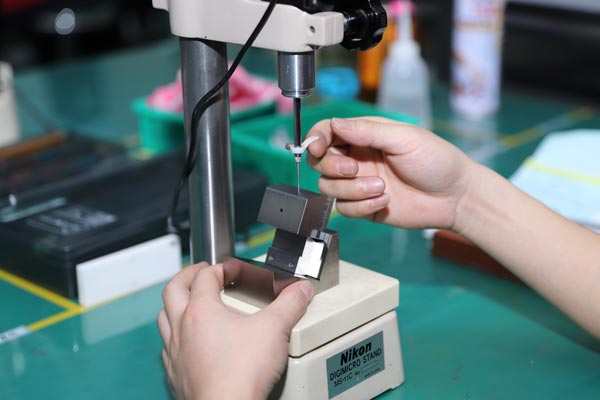
II. Detection Methods for the Accuracy of Tungsten Carbide Dies
1. Visual Inspection
Visual inspection is one of the simplest and most direct methods for detecting the accuracy of tungsten carbide dies. By observing the die surface with the naked eye or a magnifying glass, one can check for defects, cracks, bubbles, etc., as well as whether the geometric shape and dimensions of the die meet the requirements. Although visual inspection is easy to perform, it can only detect surface defects and is powerless against defects inside the die or in its microstructure.
2. Magnetic Particle Inspection
Magnetic particle inspection is a method that utilizes the magnetism of tungsten carbide and changes in the magnetic field to detect defects. After applying magnetic powder to the die surface, an electric current is passed through to make the magnetic powder form magnetic charges at the defect sites. By observing the shape and size of these magnetic charges, the quality of the die can be judged. Magnetic particle inspection can detect both internal and surface defects but is not suitable for non-magnetic tungsten carbide dies.
3. Ultrasonic Inspection
Ultrasonic inspection is a method that uses the penetrability and reflectivity of ultrasonic waves to detect internal defects in tungsten carbide dies. By introducing ultrasonic waves into the die material and observing the reflection and propagation process of the sound waves, one can determine whether there are defects inside the die. Ultrasonic inspection offers high accuracy and sensitivity and can detect both internal and surface defects, but it requires professional equipment and technical support.
4. Coordinate Measuring Machine Inspection
A coordinate measuring machine is a high-precision measuring device that can measure the three-dimensional dimensions and shape accuracy of a die. By placing the die to be measured on the worktable of the measuring machine and using the probe of the machine to scan and measure the die surface, three-dimensional data of the die can be obtained. Then, by comparing the measured data with standard data, one can determine whether the die’s accuracy is qualified. Coordinate measuring machine inspection is characterized by high accuracy, high efficiency, and high automation and is an important means for detecting the accuracy of tungsten carbide dies.
III. Measures for Ensuring the Accuracy of Tungsten Carbide Dies
1. Strict Material Selection
The accuracy and performance of tungsten carbide dies are closely related to the quality of their materials. Therefore, when manufacturing tungsten carbide dies, high-quality, high-purity tungsten carbide materials should be selected, and the chemical composition and physical properties of the materials should be strictly controlled. At the same time, the materials should also undergo strict inspection and screening to ensure that their quality meets the manufacturing requirements.
2. Precision Machining
The accuracy and performance of tungsten carbide dies are also closely related to their machining accuracy. Therefore, precision machining equipment and processes, such as CNC machine tools and laser processing, should be adopted during the machining process. At the same time, quality control over the machining process should be strengthened to ensure that the machining accuracy and dimensional stability meet the requirements.
3. Rational Design
Die design is one of the important links in die manufacturing. Rational design can fully consider the usage conditions and requirements of the die, avoiding the impact of design defects and unreasonable structures on the die’s accuracy. When designing a die, factors such as the physical and chemical properties of the material, the structure and function of the components, and the manufacturing process should be fully considered to ensure the rationality and feasibility of the die design.
4. Strict Inspection
After the die manufacturing is completed, strict inspection and testing should be carried out to ensure that the die’s accuracy and performance meet the requirements. The inspection content includes dimensional accuracy, shape accuracy, positional accuracy, and surface quality. For unqualified dies, timely repair or scrapping should be carried out to avoid adverse effects on subsequent production.
5. Regular Maintenance
Dies are subject to various factors during use, such as wear and deformation. Therefore, regular maintenance and upkeep of the die are important measures for maintaining its accuracy and performance. Maintenance content includes cleaning, lubrication, and fastening. At the same time, the die should also be regularly inspected and evaluated to detect and solve problems in a timely manner.
IV. 결론
The detection and assurance of the accuracy of tungsten carbide dies are important topics in the die manufacturing field. By adopting appropriate detection methods and assurance measures, the accuracy and performance of tungsten carbide dies can be ensured to meet the requirements, improving product quality and production efficiency. In the future, with the continuous progress of science and technology and the development of manufacturing technology, the detection and assurance of the accuracy of tungsten carbide dies will become even more precise and efficient.



 English
  Deutsch
  Français
  日本語
日本語  한국어
한국어  Español
  Português
  Italiano
  Nederlands
  Русский
  Bahasa Indonesia
  العربية