
Application Characteristics of Tungsten Carbide Dies in the Electronics Industry
The electronics industry is undergoing unprecedented rapid iteration. Product miniaturization, precision engineering, and high performance have become irreversible trends, placing extremely stringent demands on the comprehensive performance of die materials. […]
The electronics industry is undergoing unprecedented rapid iteration. Product miniaturization, precision engineering, and high performance have become irreversible trends, placing extremely stringent demands on the comprehensive performance of die materials. Tungsten carbide dies, with their high hardness, high wear resistance, high thermal stability, and excellent machining adaptability, occupy a core position in electronic manufacturing. This article systematically analyzes the application value of tungsten carbide dies in the electronics industry from three dimensions: performance characteristics, industry demands, and typical applications.
I. Core Performance Characteristics of Tungsten Carbide Dies
Tungsten carbide dies belong to the cemented carbide material category, sintered through powder metallurgy from elements such as tungsten and cobalt, and possess multiple outstanding properties.
La nostra attività in fabbrica: parti in metallo duro, parti di stampi, stampi a iniezione medicali, stampi a iniezione di precisione, stampaggio a iniezione di teflon PFA, raccordi per tubi PFA. e-mail: [email protected],whatsapp:+8613302615729.
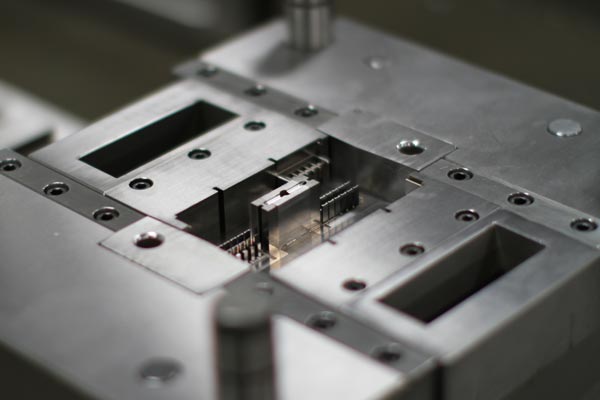
High hardness and high wear resistance. Tungsten carbide reaches a hardness of HRA88 to 92, maintaining stable cutting and forming performance under extreme conditions such as high speed, high pressure, and high temperature. Die life far exceeds that of conventional steel.
Excellent thermal stability. Thermal deformation under high-temperature environments is minimal, ensuring that the die maintains machining precision and dimensional consistency during continuous operation. This is critical for the precision manufacturing of electronic products.
Strong corrosion and oxidation resistance. The material remains performance-stable across a variety of chemical media, making it suitable for production scenarios in the electronics industry involving special surface treatments and cleaning processes.
Good machining adaptability. Tungsten carbide can be precision-machined into complex cavities and micro-fine structures, meeting the diverse and personalized die requirements of the electronics industry.
II. Core Demands of the Electronics Industry for Dies
The die requirements of the electronics industry can be summarized into four key dimensions.
Precision requirements continue to rise. Products are continuously miniaturized, and component dimensional tolerances have entered the micrometer range. Dies must deliver long-term stable machining precision.
Delivery cycles are constantly compressed. Product iteration speed is accelerating, and the cycle from die design to delivery is being significantly shortened, placing higher demands on both material machining efficiency and die life.
Diversification demands are increasingly prominent. Electronic product categories are vast, and dies must accommodate different materials and structural forming requirements. Flexible manufacturing capability has become a rigid need.
Durability and reliability are the baseline. Dies must maintain consistent performance under high-load, long-cycle operation. Any early failure directly impacts line capacity and product yield.
III. Five Application Advantages of Tungsten Carbide Dies in the Electronics Industry
Capacità di lavorazione ad alta precisione
The high hardness and low wear rate of tungsten carbide enable it to maintain dimensional accuracy and surface quality consistency over long-term use. In the machining of precision components such as mobile phone housings, circuit boards, and sensors, tungsten carbide dies can stably deliver micrometer-level tolerances, ensuring product performance compliance.
High-Speed and High-Pressure Condition Adaptability
Electronic product injection molding typically involves high-temperature and high-pressure environments. Tungsten carbide dies can withstand the sustained impact of high-speed injection pressure and high-temperature molten material, ensuring that forming precision and surface finish do not degrade due to die deformation.
Complex Structure Machining Advantage
Electronic product structures are becoming increasingly complex. Micro-holes, deep slots, and irregular cavities place extremely high demands on die machining capability. The good machinability of tungsten carbide allows it to be precisely manufactured into various complex geometries, providing full process freedom for product design.
Durability and Operational Reliability
Tungsten carbide dies exhibit an extremely low wear rate and very high dimensional stability under high-load continuous production, significantly extending die service life, reducing replacement frequency and downtime risk, and directly improving overall line efficiency.
Environmental Sustainability
Tungsten carbide dies produce no harmful substances during manufacturing and use, complying with the increasingly strict environmental regulations in the electronics industry. Meanwhile, their ultra-long service life significantly reduces die waste volume, aligning with the industry direction of sustainable manufacturing.
IV. Typical Application Cases
Mobile Phone Housing Injection Molds
Mobile phone housings demand extremely high surface quality and dimensional precision. Tungsten carbide dies, with their high hardness and wear resistance, maintain cavity stability during high-temperature and high-pressure injection molding, ensuring forming precision and appearance consistency of the housing while significantly reducing die maintenance and replacement frequency.
Circuit Board Punching and Forming Dies
Circuit board manufacturing involves a large volume of micro-hole and precision slot processing. Tungsten carbide dies ensure long-term controllability of hole size and positional accuracy through their high precision and stability. Their wear resistance further guarantees sustained consistency during high-volume production.
Sensor Precision Dies
Sensors are among the most critical components in the electronics industry, with extremely stringent requirements for die machining precision and stability. Tungsten carbide dies are widely used in sensor manufacturing, including pressure sensors and temperature sensors. The high precision and stability of tungsten carbide dies ensure the performance and reliability of sensors.
In summary, the application characteristics of tungsten carbide dies in the electronics industry are primarily reflected in high-precision machining, high-speed and high-pressure processing, complex structure machining, durability and reliability, as well as environmental sustainability. These characteristics make tungsten carbide dies an indispensable key tool in the electronics industry, providing strong manufacturing support for the continuous innovation of electronic products.

 English
  Deutsch
  Français
  日本語
日本語  한국어
한국어  Español
  Português
  Italiano
  Nederlands
  Русский
  Bahasa Indonesia
  العربية