

A Comprehensive Analysis of Optimization Strategies for Tungsten Carbide Die Processing Flow
Tungsten carbide dies play a pivotal role in a wide range of industrial manufacturing fields due to their high strength, excellent wear resistance, and good thermal stability. However, the processing […]
Tungsten carbide dies play a pivotal role in a wide range of industrial manufacturing fields due to their high strength, excellent wear resistance, and good thermal stability. However, the processing of tungsten carbide dies is extremely complex and highly technical. How to optimize their processing flow to enhance production efficiency, reduce costs, and ensure die quality has long been a focal point of concern in the manufacturing industry. This article will delve into the optimization strategies for the processing flow of tungsten carbide dies.
I. Material Management: Precise Selection and Scientific Pre-treatment
Rational Material Selection
There is a diverse range of tungsten carbide materials, and different dies have varying requirements for properties such as hardness, wear resistance, and toughness, depending on their specific uses and working conditions. For instance, dies used for high-precision stamping need to possess high hardness and wear resistance to maintain dimensional accuracy during long-term use. In contrast, dies for complex-shaped forming processes require relatively high toughness to prevent fractures during processing. Therefore, when selecting materials, it is crucial to comprehensively consider the working environment and performance requirements of the dies to accurately choose the most suitable tungsten carbide material, avoiding material waste or insufficient performance.
Our factory business: carbide parts, mold parts, medical injection molds, precision injection molds, teflon PFA injection molding, PFA tube fittings. email: [email protected],whatsapp:+8613302615729.
Scientific Material Pre-treatment
Proper pre-treatment of tungsten carbide materials before formal processing is of great significance. Common pre-treatment methods include annealing and normalizing. Taking annealing as an example, it can eliminate internal stresses within the material, making the material’s microstructure more uniform and stable, thereby significantly improving its machinability. After pre-treatment, the probability of problems such as cracks and deformations during subsequent processing is greatly reduced, laying a solid foundation for the smooth progress of subsequent processing steps.
II. Design and Planning: Optimizing Die Design and Process Routes
Die Design Optimization
The rationality of die design directly affects the difficulty and quality of processing. During the design process, it is advisable to avoid excessive sharp corners and thin-walled structures as much as possible. Sharp corners are prone to stress concentration, which can easily lead to cracks during processing and use. Thin-walled structures have poor rigidity and are susceptible to deformation during processing. By optimizing the die structure and reducing these unfavorable factors, the processing difficulty can be effectively reduced, and the processing accuracy and quality of the die can be improved.
Process Route Planning
Formulating a detailed and reasonable processing route is the key to improving processing efficiency and quality. The process route should cover aspects such as the setting of cutting parameters, the selection of cutting tools, and the use of cooling fluids. For example, according to the characteristics of tungsten carbide materials and processing requirements, reasonably selecting cutting speeds, feed rates, and cutting depths can ensure both processing efficiency and prevent excessive tool wear or a decline in processing quality due to improper parameters. At the same time, choosing appropriate cutting tools and cooling fluids can further enhance the stability and surface quality of processing.
III. Processing Optimization: Multiple Strategies to Enhance Processing Efficiency
Separate Rough and Finish Machining
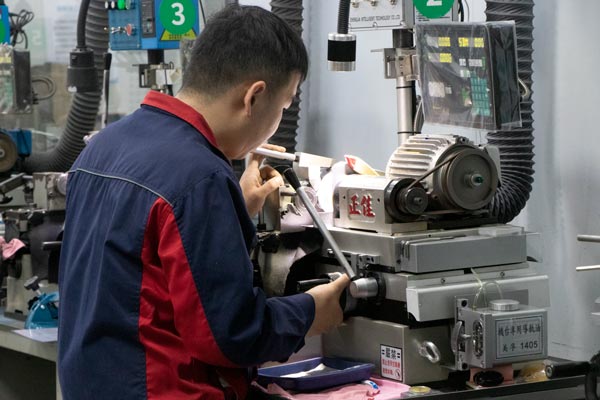
Separating rough and finish machining is an effective processing strategy. In the rough machining stage, relatively large cutting parameters are used to quickly remove excess material, leaving sufficient machining allowance for subsequent finish machining. In the finish machining stage, smaller cutting parameters are employed to finely process the die to ensure its accuracy and surface quality. This processing method can not only effectively reduce processing time but also decrease tool wear and extend tool life.
Adopt High-speed Cutting Technology
High-speed cutting (HSC) technology, as an advanced processing technology, has significant advantages in the processing of tungsten carbide dies. By increasing the cutting speed and feed rate, high-speed cutting technology can greatly shorten processing time. At the same time, the cutting force and thermal deformation generated during high-speed cutting are relatively small, which helps to improve processing accuracy and surface quality. For example, in the processing of some dies with extremely high precision requirements, high-speed cutting technology can significantly improve the dimensional accuracy and surface roughness of the dies.
Utilize Advanced Cutting Tools and Coating Technologies
The performance of cutting tools directly affects processing efficiency and quality. Selecting high-performance cutting tool materials, such as cemented carbide tools, can improve the hardness and wear resistance of the tools, making them more durable when processing tungsten carbide materials. In addition, applying coating technologies to the surface of cutting tools, such as coating with diamond or titanium nitride coatings, can further enhance the cutting performance and durability of the tools. Coated tools can effectively reduce friction and wear between the tool and the workpiece, lower the cutting temperature, and thus extend the tool life and improve processing efficiency.
Rational Use of Cooling Fluid and Lubricant
The rational use of cooling fluid and lubricant during the processing can play a crucial role. Cooling fluid can quickly carry away the heat generated during processing, reduce the cutting temperature, and prevent workpiece deformation due to thermal effects, thereby ensuring processing accuracy. At the same time, lubricant can reduce the friction resistance between the cutting tool and the workpiece, decrease the cutting force, and improve the cutting performance of the tool. For example, in some high-speed cutting processes, using appropriate cooling lubricants can effectively improve processing efficiency and tool life while ensuring processing quality.
IV. Quality Control: Real-time Detection and Process Control
Online Detection Technology
Introducing advanced online detection technologies, such as laser ranging and machine vision, can monitor the processing accuracy and quality of dies in real-time during the processing. Laser ranging technology can accurately measure dimensional deviations of dies and promptly detect out-of-tolerance issues. Machine vision technology can inspect the surface quality of dies and identify surface defects such as scratches and cracks. Through online detection technology, operators can identify problems on time and make adjustments to avoid the production of a large number of non-conforming products and improve the product qualification rate.
Statistical Process Control (SPC)
Statistical process control is a quality management method based on data statistics. By collecting and analyzing various data during the processing, such as dimensional data and processing parameters, the processing can be statistically controlled. Using control charts and other tools, abnormal fluctuations during the processing can be promptly detected, key factors affecting die quality can be identified, and corresponding adjustment and control measures can be taken. Implementing statistical process control can improve the stability and controllability of the production process and ensure the consistency and stability of die quality.
V. Post-processing Maintenance: Surface Treatment and Regular Maintenance
Surface Treatment
Selecting appropriate surface treatment processes according to the uses and requirements of dies can significantly improve the performance of dies. For example, nitriding treatment can form a high-hardness and wear-resistant nitride layer on the surface of the die, enhancing its wear resistance and corrosion resistance. Chromium plating treatment can provide the die surface with excellent smoothness and corrosion resistance, extending the service life of the die. Through surface treatment, dies can maintain good performance in harsh working environments, reduce wear and corrosion, and improve operational reliability.
Regular Maintenance and Upkeep
Establishing a comprehensive die maintenance and upkeep system is an important guarantee for ensuring the long-term stable operation of dies. Regularly inspect the dies to promptly detect problems such as wear and damage, and carry out necessary repairs and replacements. For example, regularly inspect key parts of the die, such as the cavity and core, and repair or replace them on time if wear is detected. Lubricate and maintain the guiding components of the die to ensure the motion accuracy of the die. Through regular maintenance and upkeep, the service life of dies can be extended, and their performance can be kept stable, reducing production costs.
VI. Technological Upgrading: Automation and Intelligence Lead the Future
Automated Production Line
Introducing automated production lines and robot technology can achieve automated processing and detection of tungsten carbide dies. Automated production lines can automatically complete the processing steps of dies according to preset programs, reducing manual operations and improving production efficiency. Robot technology can be used for tasks such as loading and unloading and handling of dies, avoiding the impact of human factors on processing quality. For example, in some large-scale die production enterprises, the use of automated production lines and robot technology can significantly improve production efficiency, reduce labor intensity, and enhance the consistency of product quality.
Intelligent Manufacturing System
Building an intelligent manufacturing system is an effective way to achieve visualization, controllability, and intelligent management of the tungsten carbide die processing process. By collecting and analyzing various data during the production process in real-time, such as equipment operating status, processing parameters, and quality data, the production process can be comprehensively monitored and optimized. The intelligent manufacturing system can automatically adjust processing parameters according to production data, optimize the production process, improve production efficiency, and product quality. At the same time, the intelligent manufacturing system can also achieve traceability and process management, providing strong support for enterprise production management and quality control.
VII. Conclusion and Outlook
The optimization of the tungsten carbide die processing flow is a systematic project that requires careful consideration and coordinated optimization from multiple aspects, including material selection, design optimization, process route planning, quality detection and control, post-processing maintenance, and the application of automation and intelligent technologies. By comprehensively applying the above optimization strategies, the production efficiency of tungsten carbide dies can be significantly improved, costs can be reduced, and product quality can be ensured. With the continuous development and innovation of automation and intelligent technologies, the optimization of the tungsten carbide die processing flow will become more in-depth and extensive in the future, injecting strong impetus into the sustainable development and competitiveness enhancement of the manufacturing industry.




 English
  Deutsch
  Français
  日本語
日本語  한국어
한국어  Español
  Português
  Italiano
  Nederlands
  Русский
  Bahasa Indonesia
  العربية