

Comprehensive Guide to Tungsten Carbide Die Maintenance and Troubleshooting
Tungsten carbide dies, renowned for their ultra-high hardness, exceptional wear resistance, and superior compressive strength, hold an irreplaceable position in high-end manufacturing sectors such as semiconductor packaging and testing, precision […]
Tungsten carbide dies, renowned for their ultra-high hardness, exceptional wear resistance, and superior compressive strength, hold an irreplaceable position in high-end manufacturing sectors such as semiconductor packaging and testing, precision electronic stamping, automotive component forming, and medical device manufacturing. However, because tungsten carbide is inherently brittle and expensive to machine, a lack of standardized maintenance or improper handling during prolonged high-load operations can easily cause sudden tool failures, leading to costly production downtime. Establishing a scientific, standardized maintenance management workflow across the entire die lifecycle is essential to maintaining dimensional consistency and maximizing operational efficiency.
Standardized Daily Maintenance Specifications for Tungsten Carbide Dies
Proper daily maintenance significantly reduces the probability of early failure in a tungsten carbide die. Maintenance routines should be strictly performed before, during, and after operational cycles.
Our factory business: carbide parts, mold parts, medical injection molds, precision injection molds, teflon PFA injection molding, PFA tube fittings. email: [email protected],whatsapp:+8613302615729.
1. Deep Cleaning and Surface Decontamination
After stamping or forming operations, tiny metal debris, stamping oils, and resin residues tend to accumulate on die surfaces and in hard-to-reach recesses. Non-corrosive cleaning agents must be used for degreasing, and ultrasonic cleaning equipment should be utilized when necessary to remove micron-level impurities. Never use hard metal tools to scrape the working surfaces of a tungsten carbide die to avoid damaging the ultra-mirror polished finish.
2. Systematic Lubrication and Anti-Rust Management
Although tungsten carbide itself exhibits strong corrosion resistance, the steel base, guide components, and fasteners of the die assembly remain susceptible to oxidation in humid environments. During maintenance shutdowns, high-temperature anti-wear grease should be applied to moving parts such as guide pins, guide bushings, and sliders. Additionally, a thin, uniform layer of premium rust-preventive oil should be sprayed onto the cavity and cutting edges.
3. Assembly Fastening and Structural Stress Re-verification
High-frequency impact loads can cause fastening bolts to loosen or positioning pins to shift. Maintenance personnel must periodically verify the pre-tightening torque of all connections to maintain proper alignment between the upper and lower dies. For a tungsten carbide die operating under long-term high-stress conditions, periodic stress testing and stress-relief annealing should be performed to prevent internal micro-cracks from propagating into catastrophic fractures.
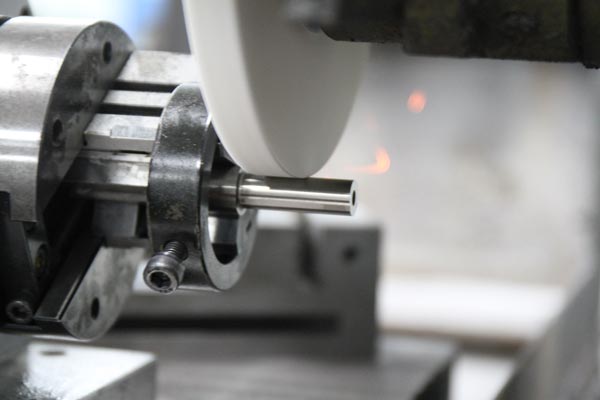
Common Fault Analysis and Troubleshooting Solutions
When failures occur in practical production, precise diagnostic and repair measures must be implemented based on the specific failure mode.
1. Chipping and Cracking Failures
Chipping typically stems from excessive impact loads, die misalignment, uneven stamping clearance, or the presence of foreign material in the feed.
- Troubleshooting Solution: First, inspect the parallelism of the press bolster and the die assembly clearance to ensure concentricity meets required standards. Next, optimize stamping speeds and cushioning parameters to reduce peak impact forces. If micro-chipping occurs, use wire EDM (Electrical Discharge Machining) or precision sinker EDM to remove the damaged layer, followed by re-polishing to a mirror finish.
2. Surface Wear and Galling Failures
When scratches appear on the product surface or dimensions undergo progressive out-of-tolerance drift, it usually indicates adhesive wear or abrasive wear on the die working surface.
- Troubleshooting Solution: Apply high-precision grinding and polishing processes to restore the surface smoothness of the die cutting edge and cavity. For highly abrasive operating environments, consider applying Diamond-Like Carbon (DLC) or Titanium Nitride (TiN) coatings to substantially increase the surface wear limit.
3. Sticking and Poor Ejection Failures
Die sticking is often caused by degraded surface roughness, spring fatigue in the stripper mechanism, or uneven cooling temperature distribution.
- Troubleshooting Solution: Inspect and replace fatigued stripper springs or ejector pin components. Finely adjust and polish the draft angles to minimize physical adhesion. For hot-forming dies, redesign or clean the cooling channels to eliminate localized overheating that leads to material thermal bonding.
4. Dimensional Deviation and Deformation Failures
Dimensional instability is primarily attributed to wear in the guiding mechanism, uneven thermal expansion, or insufficient structural rigidity of the die frame.
- Troubleshooting Solution: Calibrate the clearance of the guiding system and replace severely worn guide pins and bushings in a timely manner. Maintain a constant-temperature environment in the production workshop to minimize thermal expansion effects. Perform finite element analysis (FEA) on heavily stressed areas to reinforce the structural rigidity of the die base.
Why Choose Yize Mould?
The manufacturing and maintenance of high-precision tungsten carbide dies is a complex multidisciplinary engineering process involving materials science, precision mechanical machining, and surface engineering. Yize Mould has deeply cultivated the field of superhard materials and high-precision mold manufacturing for many years, providing global customers with professional, one-stop tooling solutions.
- Micron-Level Extreme Machining Precision: Yize Mould is equipped with state-of-the-art oil EDM, slow-feed wire EDM, and high-precision CMM inspection instruments from international leading brands, consistently maintaining component machining tolerances within ±0.001mm. This ensures absolute interchangeability and assembly precision for every tungsten carbide die.
- Advanced Superhard Material Processing: Addressing the high hardness and brittleness of tungsten carbide, Yize Mould has mastered proprietary stress-relief processes and mirror-finish polishing techniques. These technologies effectively inhibit micro-crack propagation during die operation, significantly reducing the risk of edge chipping.
- Full-Lifecycle Technical Response Services: Beyond custom R&D and high-precision manufacturing, Yize Mould offers a comprehensive service ecosystem. From fault diagnosis and failure mechanism analysis to precision refurbishment and upgrades, Yize Mould empowers clients to minimize total operating costs.
Frequently Asked Questions (FAQ)
Q: What is the typical service life of a tungsten carbide die? How can it be effectively extended? A: The service life of a tungsten carbide die depends on stock material thickness, operating conditions, and maintenance frequency. Typically, it lasts 5 to 10 times longer than conventional steel dies, achieving millions to tens of millions of strokes. Key practices to extend service life include establishing preventive maintenance protocols, ensuring optimal lubrication, and periodically submitting the die to specialized manufacturers like Yize Mould for precision re-grinding and stress relief.
Q: Can a tungsten carbide die be repaired via weld touch-ups after minor edge chipping occurs? A: Due to the poor weldability of tungsten carbide, conventional thermal welding can easily induce thermal cracking, resulting in total die failure. For minor chipping, the standard repair method involves removing the damaged area via micron-level EDM or wire EDM followed by re-polishing. If chipping is severe, Yize Mould recommends a modular insert replacement strategy to maintain dimensional accuracy while minimizing repair costs.
Q: How do you determine whether a tungsten carbide die requires shutdown for preventive overhaul? A: A shutdown and inspection are strongly advised when product burrs increase noticeably and cannot be eliminated by fine-tuning the press stroke, when abnormal vibration or noise occurs during press operation, or when critical product dimensions approach tolerance limits. Establishing a stroke-based tracking log is recommended, allowing the die to undergo full performance evaluations by Yize Mould upon reaching predefined thresholds.

 English
  Deutsch
  Français
  日本語
日本語  한국어
한국어  Español
  Português
  Italiano
  Nederlands
  Русский
  Bahasa Indonesia
  العربية