

Oil Drilling Carbide Components: Engineered Wear Resistance for the Toughest Downhole Conditions
Downhole, conventional steel reaches its limits quickly. Abrasive rock, high-velocity drilling fluid, elevated temperatures, and corrosive formation fluids combine to wear, erode, and deform metal components long before a well […]
Downhole, conventional steel reaches its limits quickly. Abrasive rock, high-velocity drilling fluid, elevated temperatures, and corrosive formation fluids combine to wear, erode, and deform metal components long before a well reaches total depth. Carbide drilling parts exist precisely to close that performance gap.
Manufactured from cemented tungsten carbide — a composite of tungsten carbide (WC) grains bonded with a metallic binder such as cobalt or nickel — these components deliver the hardness, toughness, and dimensional stability that keep drilling tools productive between trips. For drilling contractors, operators, and equipment OEMs, understanding oil drilling carbide components is essential to controlling rate of penetration (ROP), reducing non-productive time (NPT), and extending the service life of high-value downhole assemblies.
Our factory business: carbide parts, mold parts, medical injection molds, precision injection molds, teflon PFA injection molding, PFA tube fittings. email: [email protected],whatsapp:+8613302615729.
This guide explains what these components are, where they are used, how they are produced, and how to specify them correctly.
What Are Carbide Drilling Parts?
Carbide drilling parts are precision-engineered components made from cemented carbide (hardmetal) and deployed wherever drilling equipment contacts rock, fluid, or high mechanical load. In practice, they fall into two broad categories.
The first is cutting and crushing elements — the buttons, inserts, and compacts that directly engage the formation and break rock. The second is wear and flow-control components — nozzles, valve seats, bearings, bushings, and seal rings that guide drilling fluid, protect sensitive assemblies, and preserve sealing integrity.
What unites the two groups is a common performance budget: resistance to abrasive wear, resistance to erosion and corrosion, and the mechanical toughness to survive impact without chipping or fracturing. Tungsten carbide satisfies all three simultaneously, which is why it has become the default material for the most heavily loaded points in a drilling system.
Why Tungsten Carbide Outperforms Conventional Materials Downhole
The case for carbide rests on measurable material properties rather than marketing claims.
- Hardness close to diamond. Sintered tungsten carbide typically reaches HRA 85–93, with the WC phase itself in the range of roughly 1600–2400 HV. This hardness is what allows a button or insert to crush hard, abrasive formations instead of deforming under load.
- High compressive strength. Carbide performs best under compression, with compressive strength often cited in the 3000–6000 MPa range — several times that of hardened steel. Drill bit designs are built around this strength to load inserts in compression rather than in shear.
- Thermal stability. Tungsten carbide melts at approximately 2870 °C and retains useful hardness well above the temperature at which steel softens. Deep wells routinely present downhole temperatures exceeding 200 °C, and carbide maintains its integrity where competitive materials begin to lose shape.
- Corrosion and erosion resistance. Carbide resists attack from acidic formation fluids and saltwater and stands up to the abrasive particle loading carried in drilling mud, both of which rapidly degrade unprotected steel surfaces.
The one inherent weakness of pure carbide is brittleness. This is precisely why it is used as a composite: adjusting binder content and WC grain size allows manufacturers to trade a small amount of hardness for significantly greater fracture toughness, producing grades tuned to specific drilling conditions.
The Core Family of Carbide Drill Bit Components
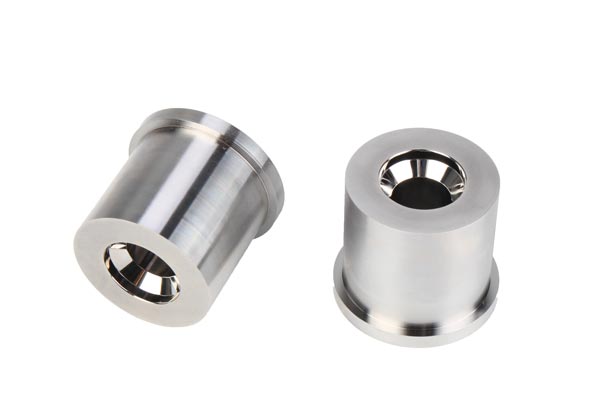
A modern drill bit is an assembly of many specialized carbide components. The most common include the following.
Tungsten Carbide Buttons and Inserts
Carbide buttons are pressed or brazed into roller cone and tricone bit cones, where they act as the primary crushing elements. Their geometry and grade are matched to their position on the cone: inner rows generally use tougher, more impact-tolerant grades, while gauge row inserts use harder, more wear-resistant grades to resist the severe abrasion at the borehole wall. Inserts are also widely specified for DTH hammers, PDC bit bodies, and mining and construction tools.
Carbide Drill Bit Nozzles
Nozzles direct high-velocity drilling fluid to cool the bit, clean the cutting face, and lift cuttings toward the surface. Because they handle abrasive, fast-moving mud, they are among the fastest-wearing parts on a bit. Carbide nozzles resist erosion far better than steel, and modern designs — including venturi and extended-venturi profiles — optimize flow while preserving the nozzle bore for longer.
Flow Control Components
In chokes, valve assemblies, and surface and subsurface control equipment, carbide valve seats, stems, cages, and orifices maintain sealing surfaces and regulate flow under high pressure and heavy solids loading. Carbide seat-and-seat-ring pairs are frequently used together for matched wear performance.
Bearings, Bushings, and Seal Rings
Radial bearings, thrust bearings, bushings, and seal rings support rotating elements in mud motors, rotary steerable systems, and other downhole tools. Carbide’s dimensional stability under heat and load helps maintain clearances and sealing integrity, reducing the risk of premature tool failure.
Wear Pads, Stabilizer Inserts, and Gauge Protection
Wear pads, stabilizer blades, and gauge protection components use carbide to shield tool surfaces from the abrasive contact that gradually opens the borehole gauge and degrades tool body geometry.
How Carbide Drilling Parts Are Manufactured
Consistency in carbide components begins with the powder-metallurgy process.
- Powder preparation. High-purity tungsten carbide powder is milled and blended with the binder metal and any grain-growth inhibitors to achieve a defined particle-size distribution.
- Compaction. The blended powder is pressed into a near-net shape using dies, isostatic pressing, or other forming methods depending on the part geometry.
- Sintering. The compact is sintered at high temperature, during which the binder melts and the part densifies to near full theoretical density. Hot isostatic pressing (HIP) is often applied to eliminate residual porosity and improve reliability.
- Precision finishing. Grinding, lapping, and surface treatment bring critical features — bores, seat faces, and sealing surfaces — to tight dimensional and geometric tolerances.
Because small variations in grain size or binder content translate into measurable differences in field life, reputable manufacturers use inspection at each stage and control grade chemistry carefully.
Matching Carbide Grades to Formation and Application
There is no single “best” carbide grade; there is only the grade best matched to a specific application.
- Coarse or extra-coarse grain grades with higher binder content favor toughness and impact resistance, making them suitable for hard, fractured formations and high-impact percussion or roller cone applications. Coarse grain structures reduce the risk of chipping and spalling under repeated shock loading.
- Fine or submicron grain grades with lower binder content favor hardness and wear resistance, suited to highly abrasive formations where maintaining gauge and edge sharpness matters more than maximizing impact toughness.
Specifying the wrong grade in either direction shortens service life: too hard a grade chips under impact, while too tough a grade wears away too quickly in abrasive rock. Working with a supplier that can map grade selection to formation type and drilling parameters is far more valuable than simply ordering the hardest available option.
Applications Across the Drilling Lifecycle
Carbide components support nearly every stage of drilling and production.
- Drilling tools and bits — buttons, inserts, nozzles, and gauge components for roller cone, PDC, drag, and DTH bits.
- Downhole tools — wear parts protecting sensors and fluid channels in MWD and LWD tools, mud motors, and rotary steerable systems.
- Fluid handling and pressure control — nozzles, chokes, valve seats, and flow cages.
- Production and pumping equipment — bushings, plungers, and sealing components used in pumping and wellhead equipment, where carbide resists abrasive and corrosive produced fluids.
What to Look for in a Carbide Components Supplier
For procurement and engineering teams, supplier capability matters as much as material grade. The most reliable partners share several characteristics.
- Grade range and documentation — a published portfolio of grades with defined binder content, grain size, hardness, and transverse rupture strength, backed by material certificates.
- Custom engineering — the ability to produce non-standard geometries and tight tolerances rather than only catalog blanks.
- In-process quality control — density, hardness, and dimensional inspection throughout production, not only at final shipment.
- Application support — technical input on grade and geometry selection based on the intended formation, bit type, and operating parameters.
Choosing a supplier on price alone frequently proves expensive in the field, where a single premature failure can cost far more than the component itself in rig time and replacement logistics.
Frequently Asked Questions
What are carbide drilling parts made of?
Most carbide drilling parts are made from cemented tungsten carbide, a composite of tungsten carbide grains bonded with a metal such as cobalt or nickel. The combination of a very hard carbide phase and a ductile binder produces a material that is both highly wear-resistant and tough enough to absorb drilling impact.
How long do carbide drilling parts last compared with steel components?
Service life depends on the grade, the application, and the formation, but carbide components generally outlast comparable steel parts by a wide margin — frequently several times longer. The improvement is greatest in highly abrasive or high-impact conditions, where steel wears or deforms quickly.
Can carbide drilling components be custom-manufactured?
Yes. Many suppliers produce custom parts to specified dimensions, tolerances, and grades, including non-standard shapes and complex geometries. Custom engineering allows the component to be matched precisely to the tool design and the drilling conditions it will face.
Why is tungsten carbide preferred over steel for drill bit components?
Tungsten carbide offers a combination of hardness, compressive strength, and thermal and corrosion resistance that steel cannot match in the same package. These properties allow carbide to crush hard formations, resist abrasive drilling fluid, and hold critical dimensions under heat and load for much longer.



 English
 Deutsch
 Français
 日本語
 한국어
 Español
 Português
 Italiano
 Nederlands
 Русский
 Bahasa Indonesia
 العربية